
Sugarcane Bagasse Tableware Coating Systems: CPET Coating vs PLA Coating vs PE Coating vs Water-Based Barrier Coating – Complete Industry Whitepaper


Introduction: Why Bagasse Tableware Needs Engineering, Not Just Sustainability

Sugarcane bagasse tableware is often marketed as a simple eco-friendly alternative to plastic. However, in real industrial applications, it is not just a “green product”—it is an engineered material system.
Raw molded fiber made from sugarcane residue has inherent limitations that restrict its direct use in food packaging:
It absorbs moisture quickly
It loses structural strength when exposed to liquids
It deforms under heat and grease exposure
It lacks barrier properties against oil and water
Because of these limitations, modern bagasse tableware relies heavily on internal coating technology to become commercially viable.
Without coating, bagasse products would fail in:
food delivery systems
airline catering
supermarket ready meals
hot and oily food applications
This is why coating is not an optional enhancement—it is a functional necessity.
What is Sugarcane Bagasse Tableware?
Sugarcane bagasse is the fibrous byproduct remaining after sugarcane juice extraction. Instead of being discarded or burned, this fibrous material is processed into molded pulp products.
Manufacturing flow of bagasse products:
Collection of sugarcane residue
Washing and impurity removal
Pulping into fiber slurry
Mold forming under vacuum pressure
Hot pressing and shaping
Drying and sterilization
Surface coating (critical step)
The final product becomes:
food containers
trays
plates
bowls
clamshell boxes
What makes bagasse attractive is its renewable origin and biodegradability, but its performance depends heavily on post-processing treatments.
Why Sugarcane Bagasse Tableware Coating is Essential

Internal coating is a thin functional layer applied to molded fiber products. Its role is not decorative—it defines whether the product can survive real-world food conditions.
1. Moisture Barrier Function
Fiber-based materials naturally contain capillary structures that absorb water. When hot soup, sauces, or beverages are placed inside, uncoated bagasse rapidly softens.
Coating creates a hydrophobic barrier that prevents liquid penetration.
2. Oil Resistance Function
Oil molecules are smaller and more penetrating than water in fiber materials. Without coating, greasy foods such as fried chicken or curry will:
seep into fiber walls
weaken structural integrity
cause leakage
Coating prevents this by modifying surface energy.
3. Heat Stability Function
Hot food creates thermal stress. Fiber expands and weakens when exposed to high temperatures.
Coating improves:
deformation resistance
thermal insulation stability
structural rigidity retention
4. Industrial Handling Stability
During logistics and stacking:
trays are compressed
boxes are stacked under weight
humidity exposure occurs
Coating ensures dimensional stability during transport.

Overview of CPET, PLA, and PE Coating Systems
In global packaging manufacturing, three coating materials dominate the bagasse tableware industry.
Each belongs to a different material philosophy:
Designed for high-temperature industrial food systems.
Designed for compostable packaging systems.
Designed for mass production efficiency.

Water-based barrier coating is a water-dispersed polymer system designed to replace traditional plastic coatings such as PE in fiber-based packaging systems.
Unlike CPET, PLA, and PE, it is not defined by a single polymer type but by a functional coating system.
How It Works
The coating forms a barrier layer through:
Water-based dispersion application
Water evaporation phase
Polymer particle coalescence
Film formation on fiber surface
Optional crosslinking reinforcement
Key Function
It mainly provides:
water resistance
grease resistance
oxygen barrier (limited)
plastic-free surface functionality
Industrial Position
Water-based coating is NOT a replacement for CPET or PLA.
It mainly targets:
👉 PE replacement in paper and molded fiber packaging
The Science Behind Coating Performance
To understand why CPET, PLA, and PE behave differently, we need to look at polymer science.
1. Molecular Structure and Heat Resistance
Heat resistance is directly linked to polymer crystallinity.
CPET → highly crystalline structure → stable under heat
PLA → semi-crystalline → moderate thermal stability
PE → flexible chain structure → low thermal resistance
Higher crystallinity = higher melting point = better heat performance.
2. Surface Energy and Liquid Resistance
Liquid resistance depends on surface energy.
PE has low surface energy → excellent water resistance
PLA has moderate surface energy → partial resistance
CPET has balanced structure → strong barrier under heat
3. Oxygen and Moisture Barrier Properties
Barrier performance is determined by molecular density.
CPET → dense structure → excellent barrier
PLA → moderate barrier
PE → good moisture barrier but weak gas barrier
CPET vs PLA vs PE: Deep Industrial & Application Analysis
CPET Coating: High-Performance Engineering Material for Extreme Conditions
CPET (Crystalline Polyethylene Terephthalate) is the most technically advanced coating material used in sugarcane bagasse tableware systems. It is not simply a waterproof layer—it is a structural performance enhancer designed for high-temperature food logistics environments.
Unlike conventional plastic coatings, CPET is engineered through a crystallization process that significantly increases its thermal resistance and dimensional stability.
CPET Material Structure and Behavior
CPET is derived from PET but undergoes a controlled crystallization process. This structural transformation changes the polymer from a flexible amorphous state into a rigid crystalline lattice.
This leads to:
higher melting point
improved heat distortion resistance
enhanced rigidity under load
better oxygen barrier performance
Because of this structure, CPET-coated bagasse products can maintain integrity in environments that would normally destroy fiber-based packaging.
Thermal Performance of CPET
CPET is widely used in applications requiring extreme heat resistance.
Typical performance range:
oven resistance: up to 220°C
microwave stability: excellent
freezing stability: down to -40°C
This makes CPET suitable for “freeze-to-oven” food systems.
In airline catering or ready-meal production, food often undergoes:
freezing
storage
reheating at high temperature
CPET is one of the few coating materials that can handle this full lifecycle.
Industrial Applications of CPET
CPET-coated bagasse products are commonly used in:
airline meal trays
premium ready-to-eat meals
institutional catering systems
high-temperature food packaging
In these environments, performance is more important than cost.
Limitations of CPET
Despite its performance advantages, CPET has several limitations:
1. High production cost
CPET requires controlled crystallization processing, increasing cost per unit.
2. Recycling complexity
Although PET is technically recyclable, multi-layer bagasse structures complicate recycling streams.
3. Low compostability
CPET is not biodegradable and does not align with composting-based sustainability systems.
PLA Coating: Bio-Based Sustainable Packaging Material
PLA (Polylactic Acid) represents a completely different philosophy from CPET. Instead of prioritizing heat performance, PLA focuses on environmental sustainability and carbon reduction.
It is produced from renewable resources such as:
corn starch
sugarcane
cassava
PLA Molecular Structure and Properties
PLA is a semi-crystalline polymer. Its structure allows it to maintain rigidity under moderate conditions but limits its thermal resistance.
Key properties include:
bio-based origin
moderate mechanical strength
transparency potential
compostability under industrial conditions
Thermal Limitations of PLA
PLA has a significantly lower heat resistance compared to CPET.
Typical range:
softening point: ~55–65°C
deformation risk: above 70°C
This means PLA-coated bagasse products are not suitable for:
boiling liquids
microwave high-power heating
oven applications
Compostability Mechanism of PLA
PLA does not degrade naturally in ambient environments. It requires industrial composting conditions:
temperature: 55–60°C
humidity: controlled
microbial activity: high
Under these conditions, PLA breaks down into:
water
carbon dioxide
biomass
This makes PLA a preferred material in regions with developed composting infrastructure.
Industrial Applications of PLA
PLA-coated bagasse products are widely used in:
salad containers
cold food packaging
bakery boxes
eco-friendly takeaway packaging
They are especially popular in:
Europe
North America
where environmental regulations are strict.
Limitations of PLA
1. Limited heat resistance
Not suitable for hot food above 70°C.
2. Infrastructure dependency
Requires industrial composting facilities.
3. Higher cost than PE
Still more expensive in mass production systems.
PE Coating: Cost-Efficient Mass Production Material
PE (Polyethylene) is the most widely used coating material in global food packaging due to its low cost and stable performance.
Unlike CPET and PLA, PE is not designed for sustainability—it is designed for scalability.
PE Molecular Structure
PE consists of long hydrocarbon chains with low polarity. This gives it excellent hydrophobic properties, making it highly resistant to water and moisture.
However, its flexible molecular structure results in:
low heat resistance
limited rigidity under high temperature
long environmental persistence
Performance Characteristics of PE
PE performs strongly in:
water resistance
oil resistance
manufacturing efficiency
But it performs poorly in:
biodegradability
high-temperature resistance
environmental sustainability
Industrial Applications of PE
PE-coated bagasse products are dominant in:
fast food packaging
takeout containers
supermarket meal trays
mass catering systems
This is because PE provides the lowest cost per unit.
Environmental Challenges of PE
PE is not biodegradable. Its environmental impact includes:
long decomposition cycle (hundreds of years)
microplastic formation
landfill accumulation
Due to this, many regions are introducing restrictions on PE-based packaging.
Cross-Material Comparison: CPET vs PLA vs PE vs Water-Based
From an industrial perspective, the three materials serve completely different market segments.
Performance Factor | CPET | PLA | PE | Water-Based |
Heat Resistance | Excellent | Low | Medium | Low |
Cost Efficiency | Low | Medium | High | Medium-High |
Sustainability | Low | High | Low | High |
Compostability | No | Yes | No | Partial (depends system) |
Plastic-free | No | Partial | No | Yes |
Industrial Maturity | High | High | Very High | Medium |
Main Application | Premium | Eco packaging | Mass market | Paper & fiber packaging |
Regulations, Market Trends, Environmental Impact & Final Decision Framework
Food Contact Regulations: Safety Standards Behind Bagasse Coating Materials
In global food packaging markets, compliance with food safety regulations is a critical requirement. Even if a material performs well technically, it cannot be used commercially unless it meets regulatory standards.
For sugarcane bagasse tableware coatings, three main regulatory systems dominate:
FDA Food Contact Regulations (United States)
In the United States, food contact materials must comply with FDA 21 CFR regulations.
CPET, PLA, and PE can all be approved for food contact applications, but they must meet:
migration limits
toxicity thresholds
additive safety requirements
Among them:
PE has the longest regulatory history
CPET is widely approved for high-temperature use
PLA is increasingly accepted due to bio-based classification
EU Regulation 10/2011 (Europe)
The European Union has one of the strictest frameworks for food contact materials.
Key requirements include:
overall migration limits
specific migration limits (SML)
temperature exposure testing
simulant testing (acid, fat, alcohol, water)
In EU markets:
PLA is strongly promoted due to sustainability policies
PE is gradually restricted in single-use applications
CPET is used mainly in premium applications
Compostability Standards (EN13432 / ASTM D6400)
These standards define whether a material can be labeled “compostable”.
EN13432 (Europe)
Requires:
90% biodegradation within 180 days
no toxic residue
disintegration under compost conditions
Defines similar requirements for industrial compostability.
Only PLA typically meets these standards among the three materials.
Environmental Impact Analysis (Lifecycle Perspective)
To fully understand coating materials, we must analyze their lifecycle environmental impact (LCA: Life Cycle Assessment).
CPET Environmental Profile
CPET is derived from petroleum-based PET.
Environmental characteristics:
high energy consumption in production
recyclable in theory
difficult separation from fiber composites
low biodegradability
From a lifecycle perspective, CPET performs well in durability but poorly in end-of-life disposal.
PLA Environmental Profile
PLA is bio-based, making it fundamentally different from petroleum plastics.
Key advantages:
renewable raw materials
lower carbon emissions during production
compostable under industrial conditions
However, its environmental benefit depends heavily on:
availability of composting infrastructure
correct waste sorting systems
Without infrastructure, PLA behaves similarly to conventional plastic waste.
PE Environmental Profile
PE has the highest environmental burden among the three materials.
Issues include:
fossil fuel dependency
extremely slow degradation
microplastic generation
landfill accumulation
Despite this, PE remains dominant due to cost advantages.
Water-Based Barrier Environmental Profile
Water-based barrier systems significantly reduce reliance on fossil-based plastics by replacing PE coatings in paper and fiber packaging.
However, environmental performance depends on:
formulation type (acrylic / PU / bio-based)
end-of-life recycling system compatibility
industrial processing energy usage
Overall, it represents a transition technology toward plastic-free packaging systems.
Global Market Trends: Shift Toward Sustainable Packaging
The global packaging industry is undergoing a structural transformation driven by environmental regulation and consumer awareness.
Europe: Fastest Transition to PLA
Europe leads global adoption of compostable materials due to:
strict plastic bans
strong circular economy policies
advanced composting infrastructure
As a result:
PLA demand is growing rapidly
PE usage is declining
CPET remains niche for high-performance applications
North America: Hybrid Material Strategy
The US and Canada follow a mixed approach:
CPET used in premium ready meals
PLA used in eco branding products
PE still widely used in mass market food delivery
The transition is gradual rather than regulatory-driven.
Asia-Pacific: Cost-Driven Market
In Asia, cost remains the dominant factor:
PE still widely used
PLA adoption increasing in export-oriented factories
CPET used in limited industrial sectors
Emerging Trend: Water-Based Barrier Adoption
A new trend is emerging in global packaging:
replacement of PE coatings in paper cups
molded fiber barrier enhancement
EU-driven plastic-free regulations
Water-based coatings are increasingly used in:
paper cups
molded fiber trays
food delivery packaging
This trend is driven by:
EU PPWR regulation
plastic reduction policies
circular economy requirements
Industry Application Mapping
Different coating materials serve different industry segments.
Food Delivery Industry
Dominant materials:
PE (cost efficiency)
PLA (eco brands)
Key requirement:
leak resistance
low cost
scalability
Airline Catering Industry
Dominant material:
CPET
Key requirement:
high heat resistance
oven compatibility
structural strength
Supermarket Ready Meals
Mixed usage depending on region:
CPET for premium meals
PE for low-cost meals
PLA for eco product lines
Institutional Catering
Includes schools, hospitals, corporate catering:
PE dominates due to cost
PLA used in sustainability programs
Decision Framework: How to Choose the Right Material
From a procurement perspective, material selection should not be based only on sustainability claims, but on functional requirements.
Choose CPET if:
food must withstand high temperatures
oven or microwave use is required
premium product positioning is needed
Choose PLA if:
sustainability branding is critical
regulatory compliance in EU markets is required
cold or low-temperature food packaging is used
Choose PE if:
cost is the primary concern
large-scale mass production is required
environmental restrictions are not strict
Choose Water-Based Barrier if:
plastic-free compliance is required
paper or molded fiber packaging is used
targeting EU sustainable packaging regulations
PE replacement is needed in low-to-medium barrier applications
Future Outlook (2025–2035): Structural Shift in Packaging Industry
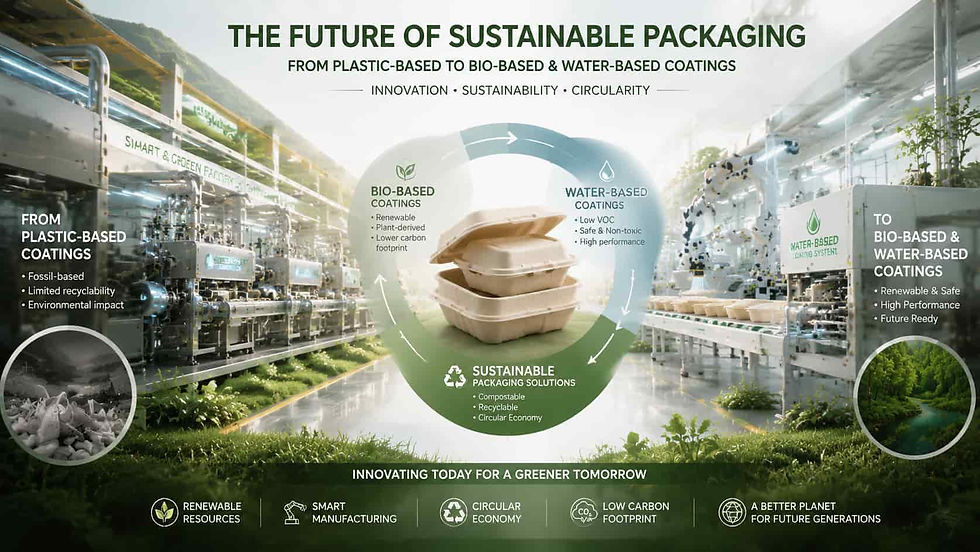
The global packaging industry is expected to undergo significant transformation over the next decade.
Trend 1: Expansion of Bio-Based Materials
PLA and other bio-based polymers will continue to expand due to:
regulatory pressure
carbon neutrality goals
consumer demand
Trend 2: Gradual Restriction of PE
PE will face increasing restrictions in:
Europe
North America
selected Asian export markets
However, it will remain dominant in price-sensitive regions.
Trend 3: CPET as Niche High-End Material
CPET will not disappear, but will become:
a specialized material for high-temperature applications
dominant in airline and premium food systems
Trend 4: Emergence of Water-Based Barrier Coating Systems (NEW)
One of the most significant emerging trends is the rapid development of water-based barrier coating technologies, which are designed to replace plastic coatings (especially PE) in paper and molded fiber packaging systems.
Unlike traditional coatings, water-based systems use water-dispersed polymer networks to create functional barrier layers without relying on continuous plastic films.
Key drivers of this trend:
global push toward plastic-free packaging
rapid growth of molded fiber packaging systems
demand for recyclable and fiber-compatible coatings
Main application areas:
paper cups
molded fiber food containers
takeaway packaging systems
retail food packaging
Overall Industry Direction
Between 2025 and 2035, the packaging industry will evolve toward a four-system coexistence model:
CPET → high-performance thermal system
PLA → bio-based compostable system
PE → cost-driven legacy system (declining)
Water-based coatings → next-generation plastic-free system (emerging growth stage)
This shift indicates that future packaging will no longer be material-centric, but function-system driven.
FAQ
1.What is the main function of coating in bagasse tableware?
It improves water resistance, oil resistance, and heat stability for real-world food applications.
2.Which coating material is most environmentally friendly?
PLA is the most environmentally friendly due to its bio-based origin and compostability.
3.Is CPET safe for food packaging?
Yes, CPET is widely approved for food contact and high-temperature applications.
4.Can PLA replace PE completely?
Not yet, due to cost and heat resistance limitations.
5.Why is PE still widely used globally?
Because it offers the lowest cost and highest production efficiency.
6.Which coating is best for hot food?
CPET is the best option for high-temperature food applications.
7.Is bagasse tableware fully biodegradable?
Only the fiber base is biodegradable; coating material determines final environmental performance.
8.What is the future of food packaging coatings?
The industry is moving toward bio-based and compostable materials like PLA.
9. What is water-based barrier coating in food packaging?
Water-based barrier coating is a water-dispersed polymer system used to replace plastic coatings such as PE in paper and molded fiber packaging. It provides water and grease resistance without forming a traditional plastic film.
10. Is water-based coating better than PE?
Water-based coatings are more environmentally friendly and better aligned with plastic-free packaging regulations, but PE still offers stronger waterproof and oil resistance performance in demanding applications.
11. Can water-based barrier coatings replace PLA or CPET?
No. Water-based coatings mainly replace PE in low-to-medium barrier applications such as paper cups and molded fiber packaging. They are not designed for high-temperature (CPET) or compostable polymer systems (PLA replacement scenarios).
12. What are the main limitations of water-based barrier coatings?
Key limitations include:
weaker oil resistance compared to PE
sensitivity to humidity and processing conditions
higher production cost in some applications
limited performance under high-temperature conditions
Final Conclusion
Sugarcane bagasse tableware coating technology has evolved from a simple functional layer into a core engineering system that defines the performance, sustainability, and regulatory compliance of modern food packaging.
In today’s global market, packaging is no longer defined by a single material choice. Instead, it is shaped by a multi-system technology framework driven by cost, performance, and environmental regulation.
Industry Evolution Insight
The global packaging industry is no longer moving toward a single “best material”.
Instead, it is shifting toward a multi-technology coexistence model, where:
CPET dominates high-temperature engineering applications
PLA leads bio-based sustainability applications
PE remains in cost-sensitive mass markets (gradually declining)
Water-based coatings enable the transition toward plastic-free fiber packaging systems
Final Industry Direction
Between 2025 and 2035, the packaging industry will be defined by one core transformation:
From plastic-dominant systems → to hybrid material + coating technology ecosystems
In this new structure, the key competitive advantage will no longer be based on a single material, but on the ability to integrate:
performance requirements
environmental compliance
cost efficiency
regulatory adaptation
Closing Insight
Sugarcane bagasse packaging is not just a sustainable alternative to plastic.
It is becoming a platform technology for next-generation food packaging systems, where coating innovation plays a decisive role in determining performance boundaries.
Among all emerging technologies, water-based barrier coatings represent the most critical transitional step toward a plastic-free packaging future.
If you are serious about sourcing eco-friendly food packaging:
👉 Don’t rely on guesswork.
We can help you:
Verify product quality
Provide certified samples
Offer stable long-term supply
Email: abel@mana-eco.com WhatsApp: +86 13867471335


Comments