
What Is Molded Fiber Packaging? The Complete Guide to Manufacturing, Materials, Applications, Sustainability and Future Trends (2026)


Introduction: Why Molded Fiber Packaging Is Becoming the Future of Sustainable Food Packaging

The global food packaging industry is undergoing one of the most significant transformations in its history. For decades, single-use plastics dominated restaurants, takeaway businesses, supermarkets, airlines, and food delivery services because they were inexpensive, lightweight, and easy to manufacture. However, increasing environmental concerns, stricter regulations, and growing consumer demand for sustainable products have accelerated the search for alternative packaging materials.
Among all emerging sustainable materials, Molded Fiber Packaging has become one of the fastest-growing solutions worldwide. Once primarily associated with egg cartons and protective industrial packaging, molded fiber technology has evolved into a sophisticated manufacturing process capable of producing high-quality food containers, plates, bowls, meal trays, cup lids, and many other packaging products.
Today, molded fiber packaging is widely used by global restaurant chains, catering companies, food delivery platforms, retailers, airlines, schools, hospitals, and institutional food service providers. Governments across Europe, North America, Asia-Pacific, and other regions are actively encouraging or mandating the replacement of traditional plastic packaging with renewable and compostable alternatives, further accelerating the industry's growth.
For importers, wholesalers, distributors, and private-label brands, understanding molded fiber packaging is no longer optional. Material selection directly affects product performance, regulatory compliance, transportation costs, customer satisfaction, and long-term business competitiveness.
This comprehensive guide explores every aspect of molded fiber packaging, including its history, raw materials, manufacturing technologies, product classifications, environmental benefits, market trends, supplier evaluation, and future innovations. Whether you are sourcing bagasse tableware, evaluating sustainable packaging solutions, or looking to expand your product portfolio, this guide provides a complete understanding of one of the world's most important packaging technologies.
What Is Molded Fiber Packaging?
Definition of Molded Fiber Packaging
Molded Fiber Packaging refers to packaging products manufactured by molding natural plant fibers into specific shapes using water, vacuum forming, pressure, and heat. Unlike conventional plastic packaging, molded fiber products are primarily made from renewable plant-based materials that can often be recycled, composted, or biodegraded under appropriate conditions.
The manufacturing process transforms cellulose fibers into durable three-dimensional products capable of protecting goods, serving food, or replacing petroleum-based disposable packaging.
Today, molded fiber packaging includes a wide variety of products, such as:
Clamshell takeaway boxes
Bowls
Cup carriers
Coffee cup lids
Fruit trays
Egg cartons
Electronics protective packaging
Medical packaging
Cosmetic packaging
Although consumers often associate molded fiber packaging with eco-friendly food containers, its applications extend across numerous industries.
Why Is Molded Fiber Packaging Called "Molded Fiber"?
The name originates from its manufacturing process.
Instead of injection molding molten plastic, manufacturers suspend natural fibers in water to create pulp. This pulp is then shaped using specially designed molds and vacuum systems. Heat and pressure remove moisture while permanently forming the desired product geometry.
The final product retains the strength and structural characteristics of compressed plant fibers rather than synthetic polymers.
This production method explains why molded fiber packaging is sometimes referred to as:
Molded pulp packaging
Molded pulp products
Fiber molded packaging
Molded cellulose packaging
Although these terms are often used interchangeably, subtle technical differences exist depending on manufacturing methods and product quality.
Why Molded Fiber Packaging Has Become So Popular
Several global trends have contributed to the rapid adoption of molded fiber packaging.
1. Global Plastic Reduction Policies
Over the past decade, governments worldwide have introduced regulations restricting single-use plastics and expanded polystyrene foam products. Many food service operators have been required to transition toward more sustainable packaging alternatives.
2. Consumer Environmental Awareness
Consumers increasingly prefer brands that demonstrate environmental responsibility. Sustainable packaging has become an important purchasing consideration, particularly among younger generations.
3. Corporate ESG Goals
Large restaurant chains and multinational food companies have established ambitious Environmental, Social, and Governance (ESG) targets. Replacing conventional plastic packaging with molded fiber products helps organizations reduce their environmental footprint while strengthening brand reputation.
4. Improvements in Manufacturing Technology
Modern thermoforming equipment, precision molds, automated production lines, and advanced quality control systems have significantly improved the appearance, durability, and consistency of molded fiber packaging.
The rapid expansion of takeaway and food delivery services has dramatically increased demand for disposable food packaging. Businesses now require products that combine convenience, food safety, sustainability, and attractive presentation.
The History of Molded Fiber Packaging
Understanding the history of molded fiber packaging provides valuable insight into why it has become one of today's fastest-growing sustainable packaging industries.
Contrary to popular belief, molded fiber packaging is not a recent invention. Its development spans more than one hundred years and reflects continuous innovation in materials science, manufacturing technology, and environmental engineering.
Early Origins: The Beginning of Molded Fiber Technology
The origins of molded fiber technology can be traced back to the late nineteenth and early twentieth centuries, when industries sought efficient methods to utilize paper pulp and recycled fibers.
One of the earliest commercial applications was the production of protective packaging for fragile products. Paper pulp could be molded into lightweight structures that absorbed impact during transportation, making it an ideal replacement for heavier wooden or metal packaging components.
Perhaps the best-known example is the molded fiber egg carton, first commercialized in the early 1900s. Its success demonstrated that molded cellulose fibers could provide both structural protection and cost-effective mass production.
This innovation laid the foundation for modern molded fiber manufacturing.
From Industrial Packaging to Food Packaging
For several decades, molded fiber products were primarily used in industrial applications, including:
Egg cartons
Fruit trays
Wine bottle protectors
Electronics packaging
Medical packaging
Consumer electronics cushioning
During this period, food service packaging continued to rely heavily on plastic, aluminum, and expanded polystyrene foam because these materials offered excellent moisture resistance and were inexpensive to produce.
However, the growing awareness of plastic pollution during the late twentieth century fundamentally changed industry priorities.
Researchers began exploring whether molded fiber could meet the demanding requirements of food packaging, including:
Heat resistance
Oil resistance
Water resistance
Structural rigidity
Food safety
Microwave compatibility
Technological breakthroughs during the 1980s and 1990s made this possible.
The Rise of Sugarcane Bagasse as a Preferred Raw Material
Although molded fiber packaging can be manufactured using various plant fibers, sugarcane bagasse quickly emerged as one of the industry's most valuable raw materials.
Bagasse is the fibrous residue remaining after sugarcane juice extraction. Historically regarded as agricultural waste or boiler fuel, it became increasingly attractive as manufacturers searched for renewable fiber sources.
Compared with traditional wood pulp, bagasse offered several significant advantages:
It is an agricultural byproduct rather than a harvested forest resource.
It has a relatively long and strong cellulose fiber structure suitable for molding.
Large quantities are generated annually in sugar-producing countries.
It supports waste utilization and circular economy principles.
It reduces dependence on virgin timber resources.
As production technologies matured, manufacturers in China, India, Thailand, Brazil, and other sugar-producing countries began investing heavily in bagasse-based molded fiber production.
This marked the beginning of today's global bagasse tableware industry.
Molded Fiber Packaging Enters the Sustainability Era
The early twenty-first century marked a turning point.
Several global trends converged:
Increasing restrictions on single-use plastics.
Growth of food delivery platforms.
Rising consumer demand for environmentally responsible products.
Corporate commitments to carbon reduction.
Advances in precision molding and automation.
These developments transformed molded fiber packaging from a niche alternative into a mainstream packaging solution.
Today, millions of molded fiber food containers are produced every day for restaurants, supermarkets, airlines, institutional catering, and retail food brands around the world.
For manufacturers such as Mana Eco, molded fiber packaging represents more than an alternative to plastic—it is a practical example of how agricultural byproducts can be transformed into high-value products that meet modern food service requirements while supporting global sustainability goals.
Raw Materials Used in Molded Fiber Packaging

The performance, appearance, durability, cost, and environmental impact of Molded Fiber Packaging are determined largely by the raw materials used during manufacturing. Although many buyers assume all molded fiber products are the same, the reality is that different plant fibers possess unique physical and chemical characteristics that directly influence product quality.
Understanding these materials is particularly important for importers, distributors, and food packaging brands because selecting the wrong material may result in higher production costs, inconsistent product performance, or failure to meet customer expectations.
Today, the molded fiber packaging industry primarily utilizes five major categories of natural fibers:
Sugarcane Bagasse
Bamboo Fiber
Wood Pulp
Recycled Paper
Wheat Straw
Each material has its own advantages, limitations, and ideal applications.
Sugarcane Bagasse: The Leading Material for Molded Fiber Packaging
Sugarcane bagasse has become the most widely recognized raw material for premium molded fiber food packaging.
Bagasse is the fibrous residue remaining after sugarcane juice extraction. Instead of being discarded or burned, this agricultural byproduct is processed into pulp and transformed into disposable food packaging.
Its popularity stems from several important advantages.
Excellent Fiber Structure
Sugarcane fibers possess an ideal balance between strength and flexibility. This allows manufacturers to produce products with:
Smooth surfaces
High structural rigidity
Uniform wall thickness
Good dimensional stability
These characteristics are especially important for food containers that must maintain their shape when filled with hot meals.
Renewable Agricultural Resource
Unlike virgin wood pulp, bagasse does not require cutting additional trees.
Every sugar harvest naturally generates bagasse as a byproduct, making it an efficient example of resource utilization within the circular economy.
Food Service Performance
Bagasse products generally provide:
Microwave compatibility
Freezer compatibility
Hot food resistance
Oil resistance
Good stacking performance
These properties explain why restaurants and food delivery companies increasingly prefer bagasse containers over traditional foam packaging.
Bamboo Fiber
Bamboo has gained popularity because of its rapid growth and renewable nature.
Compared with bagasse, bamboo fibers are generally longer and stronger. This characteristic makes bamboo suitable for certain premium molded fiber products requiring higher rigidity.
However, bamboo also presents several challenges.
Unlike bagasse, bamboo is cultivated specifically as a raw material rather than generated as an agricultural byproduct. Harvesting, transportation, and processing costs are typically higher.
Additionally, bamboo pulping often requires more intensive fiber treatment before molding.
As a result, bamboo products frequently occupy the premium end of the molded fiber packaging market.
Wood Pulp
Wood pulp represents one of the oldest raw materials used in molded fiber manufacturing.
For decades, it has been the primary source for:
Egg cartons
Industrial packaging
Protective cushioning
Virgin wood pulp provides:
Excellent fiber consistency
Reliable molding performance
Stable product quality
However, growing concerns regarding forest resources have encouraged many manufacturers to reduce reliance on virgin timber and adopt agricultural fibers whenever possible.
Recycled Paper
Recycled paper remains an economical option for many molded fiber applications.
It is commonly used in:
Electronics packaging
Industrial inserts
Protective packaging
Shipping trays
Although recycled fibers reduce production costs, repeated recycling shortens cellulose fibers.
Consequently, recycled paper generally produces products with:
Lower strength
Rougher surface finish
Reduced water resistance
For premium food packaging, manufacturers often blend recycled fibers with virgin plant fibers to improve overall performance.
Wheat Straw
Wheat straw has emerged as another agricultural fiber suitable for molded packaging.
Like bagasse, wheat straw is a crop residue.
However, wheat straw fibers are typically shorter and contain higher levels of silica, making pulping more challenging.
Although wheat straw products continue to gain popularity in certain regional markets, global production capacity remains significantly smaller than sugarcane bagasse.
Comparison of Common Molded Fiber Raw Materials
Material | Renewable | Agricultural Byproduct | Food Packaging Performance | Cost | Global Availability |
Sugarcane Bagasse | ⭐⭐⭐⭐⭐ | Yes | Excellent | Medium | High |
Bamboo Fiber | ⭐⭐⭐⭐⭐ | No | Excellent | High | Medium |
Wood Pulp | ⭐⭐⭐ | No | Good | Medium | High |
Recycled Paper | ⭐⭐⭐⭐ | Yes | Moderate | Low | Very High |
Wheat Straw | ⭐⭐⭐⭐ | Yes | Good | Medium | Medium |
This comparison demonstrates why sugarcane bagasse has become the preferred material for disposable food packaging worldwide. It combines renewable sourcing, excellent product performance, and cost competitiveness better than most alternative fibers.
How Molded Fiber Packaging Is Manufactured

Many buyers focus primarily on product appearance and price. However, experienced procurement professionals understand that manufacturing technology is equally important.
Two molded fiber containers may look almost identical, yet differences in production processes can significantly affect:
Product strength
Surface smoothness
Lid compatibility
Oil resistance
Water resistance
Stacking performance
Dimensional consistency
Understanding the manufacturing process helps buyers evaluate suppliers beyond simple quotations.
Step 1 – Raw Material Preparation
The process begins with collecting plant fibers.
For bagasse products, sugarcane residue is transported from sugar mills to pulp processing facilities.
The fibers undergo cleaning to remove:
Sand
Soil
Sugar residue
Leaves
Foreign particles
Only clean cellulose fibers proceed to the pulping stage.
Step 2 – Pulping
The cleaned fibers are mixed with water inside large pulping systems.
Mechanical agitation separates the fibers into a uniform slurry.
At this stage, manufacturers carefully control:
Fiber concentration
Water ratio
Fiber dispersion
Pulp consistency
These parameters directly influence molding quality.
Step 3 – Refining
Refining improves fiber bonding.
Specialized refining equipment gently fibrillates the cellulose fibers, increasing the contact area between individual fibers.
Benefits include:
Improved strength
Better surface finish
Enhanced moldability
Reduced product defects
Many premium manufacturers invest heavily in refining technology because it significantly affects final product quality.
Step 4 – Vacuum Forming
Vacuum forming is the heart of molded fiber production.
Metal molds containing thousands of microscopic holes draw water away from the pulp.
As water is removed, cellulose fibers accumulate uniformly on the mold surface.
The result is a wet product that already resembles its final shape.
The precision of this stage determines:
Product dimensions
Wall thickness
Surface quality
Weight consistency
Poor vacuum control often leads to uneven thickness and deformation.
Step 5 – Hot Pressing: The Key to Premium Molded Fiber Packaging
After vacuum forming, the molded product still contains a significant amount of moisture and has a relatively rough surface. At this stage, it is structurally complete but not yet suitable for commercial food packaging applications.
The next critical process is hot pressing, one of the most important steps that differentiates premium molded fiber packaging from low-cost alternatives.
During hot pressing, the semi-dry product is transferred into precision-machined heated molds. These molds typically operate between 160°C and 220°C, depending on the product design, raw material, and production technology.
Heat and pressure work simultaneously to:
Compress cellulose fibers
Remove remaining moisture
Increase product density
Improve dimensional accuracy
Produce smoother surfaces
Enhance oil and grease resistance
Improve lid sealing performance
Premium food packaging manufacturers invest heavily in high-precision CNC-machined molds because even minor dimensional variations can prevent lids from sealing correctly.
For importers sourcing takeaway containers, meal trays, or clamshell boxes, hot pressing quality directly influences customer satisfaction and product consistency.
Step 6 – Drying, Trimming and Surface Finishing
Although hot pressing removes most of the moisture, additional drying may still be required depending on the manufacturing process.
Manufacturers then perform:
Edge trimming
Flash removal
Surface cleaning
Shape correction
Automatic trimming equipment removes excess fiber around the product edges, producing a clean and consistent appearance.
Premium manufacturers generally maintain dimensional tolerances within fractions of a millimeter, ensuring compatibility between containers and lids.
Surface finishing also affects:
Product appearance
Brand perception
Printing quality
Stacking efficiency
These details are often overlooked during purchasing decisions but significantly influence the perceived quality of molded fiber packaging.
Step 7 – Quality Inspection
Modern molded fiber packaging factories rely on multiple inspection procedures before products are packed.
Typical quality control includes:
Visual Inspection
Operators inspect:
Surface defects
Color consistency
Burrs
Contamination
Mold damage
Dimension Inspection
Critical measurements include:
Length
Width
Height
Wall thickness
Lid fit
Performance Testing
Food packaging products are commonly tested for:
Compression strength
Leak resistance
Oil resistance
Heat resistance
Microwave safety
Freezer compatibility
Leading manufacturers also conduct random production sampling throughout each production shift to ensure long-term consistency.
Step 8 – Packaging and Export
Once quality inspection is complete, products are packed according to customer specifications.
Typical export packaging includes:
PE bags
Cartons
Pallets
Stretch wrapping
OEM customers may also require:
Barcode labels
Retail packaging
Custom printing
Private label cartons
Proper packaging minimizes transportation damage while maximizing container loading efficiency.
For international buyers, carton dimensions can significantly influence freight costs, especially when shipping 20GP or 40HQ containers.
Types of Molded Fiber Packaging
Not all molded fiber packaging products are manufactured using the same technology.
Understanding different manufacturing methods helps buyers compare quotations more accurately and select products that match their quality expectations.
1. Thick Wall Molded Fiber
Thick wall technology represents the earliest generation of molded fiber manufacturing.
Characteristics include:
Thick product walls
Rough surfaces
Lower tooling costs
Simple production process
Typical applications:
Industrial packaging
Protective inserts
Heavy-duty transportation packaging
It is rarely used for premium food packaging because of its relatively rough appearance.
2. Transfer Molded Fiber
Transfer molded products are manufactured by transferring wet pulp from one mold to another before drying.
Advantages include:
Lower production cost
High production efficiency
Suitable for large-volume manufacturing
Common applications include:
Egg cartons
Cup carriers
Fruit trays
Beverage trays
Although transfer molded products offer excellent cost performance, their surface finish is generally less refined than thermoformed fiber.
3. Thermoformed Fiber Packaging
Thermoformed fiber has become the fastest-growing segment of the molded fiber packaging industry.
This technology combines:
Precision molding
Vacuum forming
High-pressure hot pressing
The result is:
Smooth surfaces
Thin walls
Excellent dimensional accuracy
Premium appearance
Better lid compatibility
Most high-end food containers, takeaway boxes, and meal trays sold in Europe and North America now utilize thermoformed fiber technology.
For brands seeking premium packaging, thermoformed fiber has become the preferred solution.
4. Processed Fiber
Processed fiber products undergo additional finishing operations such as:
Printing
Coating
Lamination
Decorative embossing
These products are commonly used in luxury retail packaging and premium consumer goods rather than disposable food packaging.
Comparison of Different Molded Fiber Technologies
Manufacturing Method | Surface Finish | Precision | Production Cost | Typical Applications |
Thick Wall | Low | Low | Low | Industrial Packaging |
Transfer Molded | Medium | Medium | Low | Egg Cartons, Cup Carriers |
Thermoformed Fiber | Excellent | Excellent | Medium | Food Containers, Meal Trays |
Processed Fiber | Premium | Excellent | High | Luxury Packaging |
For food packaging applications, thermoformed fiber generally offers the best balance of appearance, functionality, and production efficiency.
Why Thermoformed Fiber Is Becoming the Industry Standard
Several factors explain why thermoformed fiber is rapidly replacing older molded fiber technologies.
Superior Consumer Experience
Smooth surfaces and precise dimensions create packaging that resembles premium plastic products while maintaining the sustainability benefits of plant fibers.
Better Food Performance
Thermoformed products typically exhibit:
Improved leak resistance
Better grease resistance
Stronger structural rigidity
Enhanced stackability
Improved Branding Opportunities
High-quality surfaces allow:
Better embossing
Sharper printing
Premium product presentation
For restaurant chains and food delivery brands, packaging has become an extension of brand identity.
Buyer Tips: How to Compare Molded Fiber Packaging Suppliers
When evaluating suppliers, buyers should avoid comparing prices alone.
Instead, request information regarding:
Manufacturing technology
Mold precision
Product weight tolerance
Moisture content
Quality inspection procedures
Food contact certifications
Compostability certifications
Production capacity
A slightly higher product price often reflects superior manufacturing processes that reduce complaints, improve customer satisfaction, and lower total procurement costs.
Applications of Molded Fiber Packaging
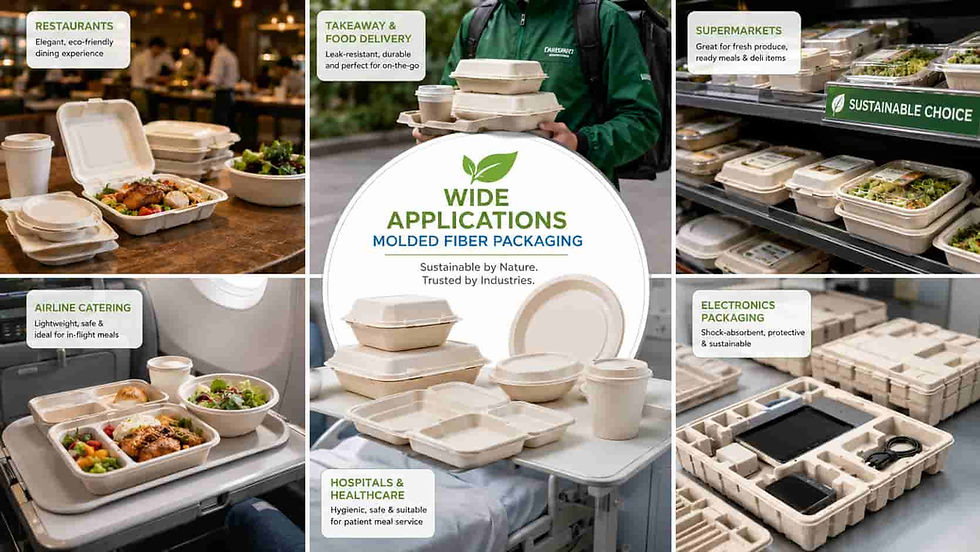
The versatility of Molded Fiber Packaging has enabled its adoption across numerous industries. While many people associate molded fiber primarily with disposable tableware, modern manufacturing technologies have expanded its applications far beyond food service.
Today, molded fiber products are used in retail, healthcare, agriculture, electronics, hospitality, and industrial packaging. Their ability to combine sustainability, functionality, and cost-effectiveness makes them one of the fastest-growing packaging solutions worldwide.
Restaurant & Takeaway Packaging
Restaurants remain the largest users of molded fiber packaging.
Common products include:
Clamshell food containers
Lunch boxes
Burger boxes
Plates
Bowls
Meal trays
Sauce cups
Modern thermoformed bagasse products provide excellent performance for hot meals, oily foods, and takeaway applications.
Food Delivery Platforms
The rapid expansion of food delivery has dramatically increased demand for sustainable disposable packaging.
Delivery platforms require packaging that offers:
Leak resistance
Heat retention
Structural stability
Stackability
Attractive presentation
Thermoformed molded fiber products have become the preferred choice for many premium restaurant brands.
Supermarkets & Fresh Produce
Supermarkets increasingly use molded fiber trays for:
Fresh fruit
Vegetables
Meat
Seafood
Bakery products
Compared with expanded polystyrene foam trays, molded fiber trays reduce plastic consumption while enhancing sustainability branding.
Airlines & Catering Services
Many international airlines are replacing plastic meal trays with molded fiber alternatives to reduce waste and meet corporate sustainability goals.
Typical airline applications include:
Meal trays
Snack boxes
Dessert bowls
Coffee cup lids
Healthcare & Institutional Catering
Hospitals, schools, universities, and government institutions are adopting molded fiber packaging because it combines food safety with environmental responsibility.
Industrial Protective Packaging
Beyond food service, molded fiber is widely used for:
Consumer electronics
Home appliances
Wine bottles
Medical equipment
Cosmetics
Glassware
These applications demonstrate that molded fiber is no longer limited to disposable tableware.
Molded Fiber Packaging vs Other Packaging Materials
Choosing the right packaging material requires balancing sustainability, product performance, cost, regulatory compliance, and customer expectations.
The following comparison highlights the strengths and limitations of the most common packaging materials.
Feature | Molded Fiber | Plastic | EPS Foam | PLA | Paperboard |
Renewable Raw Material | ✅ | ❌ | ❌ | ✅ | ✅ |
Compostable | ✅ | ❌ | ❌ | Industrial Compost Only | Depends on Coating |
Microwave Safe | ✅ | Some | ❌ | Limited | Depends |
Oil Resistance | Excellent | Excellent | Good | Good | Moderate |
Heat Resistance | Excellent | Moderate | Moderate | Limited | Moderate |
Environmental Impact | Low | High | Very High | Medium | Medium |
Plastic-Free | ✅ | ❌ | ❌ | ❌ | Mostly |
Suitable for Hot Meals | Excellent | Good | Good | Moderate | Moderate |
For most food service applications, molded fiber packaging provides the best balance between sustainability, functionality, and regulatory compliance.
Global Market Growth of Molded Fiber Packaging
Over the past decade, the molded fiber packaging industry has experienced remarkable growth.
Several key drivers continue to accelerate market expansion:
Global plastic reduction policies
Consumer demand for sustainable products
Growth of food delivery services
Corporate ESG commitments
Advances in molded fiber manufacturing technologies
Industry analysts project continued double-digit growth across many regional markets, particularly in North America, Europe, and Asia-Pacific.
China remains the world's largest manufacturing base for molded fiber food packaging, while demand continues to increase in the United States, Canada, Germany, France, Australia, and the United Kingdom.
Future Trends in Molded Fiber Packaging
The molded fiber packaging industry continues to evolve rapidly. Several technological and regulatory developments are expected to shape the market over the next decade.
PFAS-Free Manufacturing
Governments and major food brands increasingly require packaging products that are free from intentionally added PFAS chemicals.
Manufacturers investing in PFAS-free barrier technologies are expected to gain a significant competitive advantage.
AI-Powered Quality Inspection
Artificial intelligence is beginning to transform quality control within molded fiber manufacturing.
AI vision systems can detect:
Surface defects
Product deformation
Edge damage
Color inconsistencies
This technology improves consistency while reducing manual inspection costs.
Smart Automated Factories
Future production facilities will increasingly incorporate:
Robotic handling systems
Automated mold changes
Intelligent production scheduling
Digital quality tracking
Energy monitoring
These innovations improve efficiency while reducing manufacturing costs.
Circular Economy Integration
Rather than focusing solely on biodegradable products, future packaging systems will emphasize complete circularity.
This includes:
Renewable raw materials
Recyclable production waste
Composting infrastructure
Carbon reduction
Resource recovery
How to Choose the Right Molded Fiber Packaging Manufacturer
Selecting the right manufacturing partner is just as important as selecting the right material.
Professional buyers should evaluate suppliers using multiple criteria rather than price alone.
Manufacturing Capability
Ask suppliers about:
Factory size
Production capacity
Number of molding machines
Automation level
Product Certifications
Verify certifications such as:
BPI
OK Compost
FDA Food Contact Compliance
LFGB
FSC (where applicable)
Product Development
Evaluate whether the manufacturer offers:
OEM services
Custom molds
Private label packaging
Printing solutions
New product development
Quality Management
A reliable supplier should maintain strict quality management systems, including:
Incoming material inspection
In-process quality control
Final inspection
Shipment inspection
Conclusion
Molded Fiber Packaging has evolved from a simple protective packaging material into one of the world's most important sustainable packaging solutions.
Driven by environmental regulations, consumer expectations, and technological innovation, molded fiber products are replacing conventional plastic packaging across restaurants, food delivery, retail, healthcare, and industrial sectors.
Among all available fiber materials, sugarcane bagasse has emerged as the preferred raw material due to its renewable origin, excellent performance, and compatibility with circular economy principles.
For importers, distributors, and food packaging brands, understanding molded fiber technology is no longer simply an environmental consideration—it is a strategic business decision.
As manufacturing continues to advance through PFAS-free materials, AI-powered quality control, and smart automation, molded fiber packaging will remain at the forefront of the global transition toward sustainable food packaging.
Frequently Asked Questions (FAQ)
1.What is molded fiber packaging?
Molded fiber packaging is packaging manufactured from plant-based cellulose fibers using molding, vacuum forming, heat, and pressure.
2.Is molded fiber packaging compostable?
Most molded fiber products made from bagasse, bamboo, or other natural fibers are industrially compostable, and many are also suitable for commercial composting systems when certified.
3.Is molded fiber packaging biodegradable?
Yes. Under appropriate composting or natural environmental conditions, molded fiber products biodegrade significantly faster than conventional plastics.
4.What materials are used to make molded fiber packaging?
Common materials include sugarcane bagasse, bamboo fiber, wood pulp, recycled paper, and wheat straw.
5.Is bagasse better than paper pulp?
For many food packaging applications, bagasse offers superior sustainability advantages because it is an agricultural byproduct with excellent molding performance.
6.Can molded fiber replace plastic packaging?
For many disposable food packaging applications, molded fiber can successfully replace plastic and EPS foam products while reducing environmental impact.
7.Is molded fiber microwave safe?
Most high-quality molded fiber food containers are microwave safe, although users should always follow the manufacturer's usage guidelines.
8.Is molded fiber suitable for freezer use?
Yes. Many molded fiber containers perform well in refrigerated and frozen food applications.
9.What is thermoformed fiber?
Thermoformed fiber is a premium molded fiber manufacturing process that produces smooth, high-precision food packaging products.
10.Why is molded fiber packaging becoming more popular?
Growing plastic regulations, sustainability initiatives, consumer demand, and improvements in manufacturing technology continue to drive global adoption.
If you are serious about sourcing eco-friendly food packaging:
👉 Don’t rely on guesswork.
We can help you:
Verify product quality
Provide certified samples
Offer stable long-term supply
Email: abel@mana-eco.com WhatsApp: +86 13867471335


Comments