
Global Compostable Tableware Market Trends: What Buyers Should Expect Between 2026 and 2030

Updated: Apr 14
Over the past decade, the global food packaging industry has undergone a noticeable shift. What was once a niche category — compostable tableware — is gradually becoming a mainstream packaging solution across many foodservice sectors.
For importers, distributors, and food brands, the question is no longer whether sustainable packaging will grow, but how fast the transition will happen and which materials will dominate the market.
Several structural forces are pushing this transformation forward. Government regulation, consumer pressure, and large retailer sustainability commitments are all reshaping the packaging supply chain.
Understanding these trends is increasingly important for buyers planning long-term sourcing strategies.

Regulatory Pressure Is Reshaping the Packaging Industry
In many markets, regulation is now the primary driver behind the adoption of compostable food packaging.
The European Union’s Single-Use Plastics Directive has already restricted a range of disposable plastic products, forcing foodservice operators to explore alternative materials. Similar policy movements are emerging in other regions. Canada has introduced nationwide plastic restrictions, while several U.S. states are implementing their own bans on expanded polystyrene and certain plastic utensils.
These policies do not automatically require compostable packaging, but they significantly reduce the viability of conventional plastics in many foodservice applications.
For importers, this regulatory pressure creates a new procurement reality. Products must meet environmental claims that can withstand regulatory scrutiny. Certification standards such as EN13432 or BPI compostability verification are no longer optional in many distribution channels.
Manufacturers able to provide verified compliance documentation are therefore gaining strategic advantage in global markets.
Food Delivery and Takeaway Are Expanding the Market
Another major driver is the rapid growth of takeaway and delivery services.
Online food delivery platforms have dramatically increased the amount of single-use packaging circulating in urban environments. Restaurants that once relied on reusable plates now require large quantities of disposable containers.
As cities attempt to reduce plastic waste, compostable alternatives are gaining attention as a practical solution.
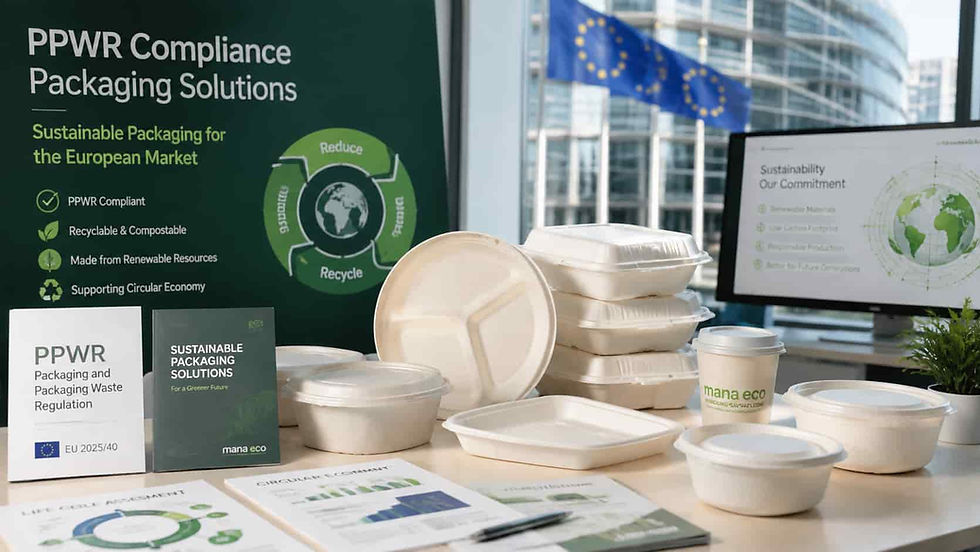
Plant-fiber packaging — particularly products made from sugarcane bagasse — has emerged as one of the most scalable options. Bagasse is a by-product of the sugar industry and can be molded into durable food containers capable of handling hot meals, sauces, and oils.
This balance of performance and environmental positioning has made molded fiber tableware increasingly attractive to restaurants, catering companies, and supermarket ready-meal programs.

Material Competition: Bagasse, PLA, and Paper
Despite the overall growth of sustainable packaging, the industry is still experimenting with different materials.
PLA plastics, molded fiber, coated paper, bamboo pulp, and palm leaf products all compete in the disposable tableware space.
However, each material comes with trade-offs.
PLA products perform well for cold beverages but have lower heat resistance. Paper products are widely available but often require plastic coatings that complicate compostability claims. Natural leaf products can be compostable but are difficult to scale for mass foodservice use.
Molded fiber packaging has gained momentum largely because it balances industrial scalability, structural strength, and relatively stable raw material supply.
This is why many large manufacturers are investing heavily in molded fiber production lines. Companies such as MANA ECO have expanded bagasse tableware manufacturing capacity to support global demand for fiber-based food packaging.
Supply Chain Stability Is Becoming a Key Procurement Factor
For distributors and large food brands, sustainability claims alone are not enough. how importers evaluate compostable tableware suppliers?
Several questions now shape purchasing decisions:
Can the supplier provide consistent production capacity?
Are certifications valid for the finished product?
Does the factory have export experience with regulated markets?
Can documentation be provided quickly when customs requests it?
Importers have learned that supply chain disruptions can quickly offset any cost advantages. Delayed shipments, incorrect labeling, or incomplete certification documentation can create serious operational problems.
This has led many buyers to prioritize manufacturers with established export systems and proven quality control processes.
Manufacturing Scale Is Expanding Rapidly
One of the most significant developments in the compostable tableware industry is the expansion of automated molded fiber production.
Earlier generations of molded pulp products were often inconsistent in quality. However, modern manufacturing lines now use precision molds, controlled drying systems, and automated trimming equipment to produce much more refined packaging.
These technological improvements have allowed manufacturers to achieve better product strength, smoother surfaces, and more consistent dimensions.
Manufacturers such as MANA ECO have invested in advanced molded fiber equipment capable of producing large volumes of compostable food packaging while maintaining strict quality standards required for international markets.
This industrialization of molded fiber manufacturing is helping the industry move beyond small-scale eco products into large commercial foodservice supply chains.
Market Demand Will Continue to Expand Through 2030
Looking ahead, most industry analysts expect compostable food packaging demand to continue rising over the next five years.
Several trends support this outlook.
First, plastic regulations are likely to expand. More countries are evaluating policies that limit single-use plastics in foodservice packaging.
Second, corporate sustainability commitments are becoming more serious. Large restaurant chains and retailers are setting public targets to reduce plastic waste in their packaging systems.
Third, improvements in molded fiber technology are making compostable packaging more competitive in terms of cost and performance.
As production capacity increases and logistics networks mature, compostable tableware is gradually moving from a niche product category into a mainstream packaging solution for global foodservice markets.

The Role of Manufacturers in Supporting the Transition
While demand for sustainable packaging is rising, the pace of adoption depends heavily on the capabilities of manufacturers.
Suppliers must do more than produce environmentally friendly products. They must also support importers with certification documentation, quality testing, and reliable production schedules.
Manufacturers such as MANA ECO are investing in technology development and production efficiency to help global buyers transition from plastic packaging to compostable alternatives without sacrificing performance or supply stability.
For many food brands and distributors, working with experienced producers is becoming a critical part of building a sustainable packaging strategy.
Frequently Asked Questions
What is compostable tableware made from?
Most compostable tableware is made from plant-based materials such as sugarcane bagasse, bamboo fiber, or PLA bioplastics. Among these materials, bagasse molded fiber has become one of the most widely used solutions for food packaging due to its strength and heat resistance.
Why is compostable tableware becoming more popular?
Government regulations restricting single-use plastics, along with growing consumer awareness about sustainability, are accelerating demand for compostable food packaging across many markets.
Is bagasse tableware better than paper packaging?
Bagasse tableware often provides better heat resistance and structural strength compared with standard paper packaging. It also avoids the need for plastic coatings that can make paper packaging difficult to compost.
Which regions have the highest demand for compostable tableware?
Europe currently leads the transition due to strong environmental regulations. However, demand is also growing quickly in North America and parts of Asia where plastic reduction policies are expanding.
Can compostable tableware replace plastic packaging completely?
In many foodservice applications, compostable materials such as molded fiber can already replace plastic packaging. However, certain applications may still require specialized materials depending on temperature resistance and shelf life requirements.
Conclusion
The global compostable tableware market is entering a new phase of growth. Regulation, consumer expectations, and foodservice industry expansion are collectively accelerating the shift away from traditional plastics.
For buyers, the challenge is not only identifying sustainable materials but also selecting suppliers capable of delivering consistent quality and regulatory compliance.
As molded fiber technology continues to evolve and production capacity expands, compostable tableware is expected to play an increasingly important role in the future of food packaging.
Manufacturers that combine technical expertise, industrial scale, and international compliance will be well positioned to support this transition in the years ahead.
Get in Touch for Quote and free Samples



Comments