
Compostable Packaging Manufacturer vs Distributor: Which Sourcing Model Is Better in 2026?

Introduction
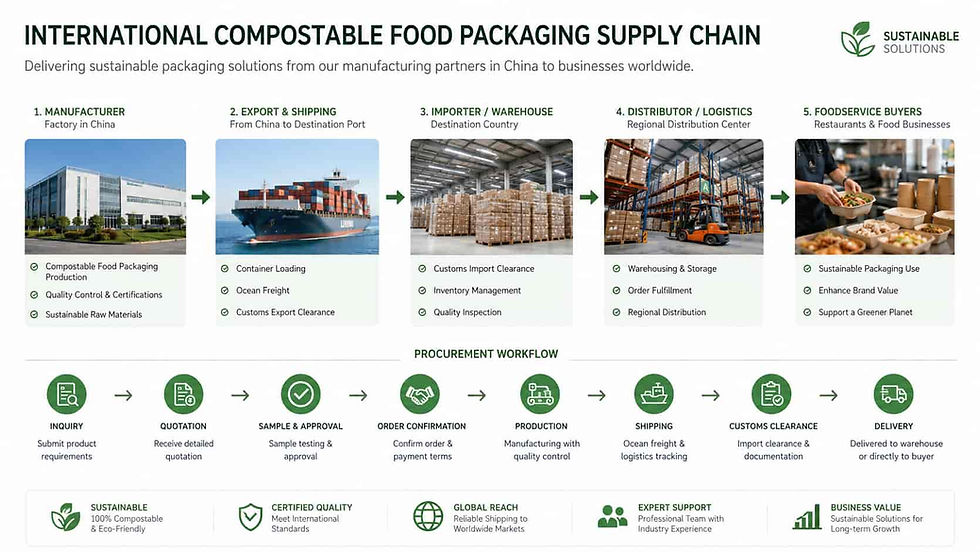
As demand for compostable food packaging continues to grow worldwide, buyers face an increasingly important sourcing decision:
Should you buy compostable packaging directly from a manufacturer or purchase through a distributor?
At first glance, the answer seems obvious. Manufacturers usually offer lower prices, while distributors provide convenience and local inventory.
However, experienced procurement professionals know the decision is far more complex.
Choosing the wrong sourcing model can result in:
Higher landed costs
Excess inventory
Cash flow pressure
Limited customization options
Supply chain disruptions
Reduced competitiveness
The best sourcing strategy depends on your business model, order volume, growth stage, and procurement capabilities.
In this guide, we will compare manufacturers and distributors from a practical procurement perspective, examining cost structures, risk factors, inventory considerations, customization opportunities, and long-term business impact.
Understanding the Compostable Packaging Supply Chain
Before comparing manufacturers and distributors, it is important to understand how compostable packaging typically moves through the supply chain.
A simplified supply chain often looks like this:
Manufacturer → Exporter → Importer → Distributor → End User
The more layers involved, the higher the final product cost.
For example, a sugarcane bagasse clamshell container may be produced in China, imported into the UK, stored by a distributor, and eventually sold to restaurants.
Each step adds:
Margin
Logistics costs
Warehousing costs
Financing costs
Operational expenses
The question buyers should ask is:
Which supply chain layer adds value, and which layer simply adds cost?
What Is a Compostable Packaging Manufacturer?
A manufacturer owns and operates production facilities that produce compostable packaging products.
Typical products include:
Bagasse clamshell containers
Plates
Bowls
Trays
Cutlery
Takeaway packaging
Manufacturers control:
Raw materials
Production scheduling
Quality systems
Product development
Packaging specifications
In many cases, manufacturers also provide export services and OEM development support.
What Is a Compostable Packaging Distributor?
A distributor purchases products from manufacturers and resells them within a specific market.
Distributors typically provide:
Local inventory
Faster delivery
Customer support
Mixed SKU purchasing
Smaller order quantities
Many restaurants and small foodservice operators prefer distributors because they can purchase products immediately without managing international procurement.
For large-volume buyers, however, the economics can be very different.
The True Cost Comparison: Manufacturer vs Distributor
Many buyers compare only the quoted product price.
This is often a mistake.
The correct comparison should focus on Total Landed Cost (TLC).
Total Landed Cost includes:
Product cost
Freight
Customs
Warehousing
Inventory carrying costs
Administrative costs
Example: Bagasse Clamshell Container
Cost Element | Manufacturer | Distributor |
Product Cost | Lower | Higher |
Ocean Freight | Buyer Pays | Included |
Customs | Buyer Pays | Included |
Inventory Storage | Buyer Manages | Distributor Manages |
Local Delivery | Additional | Included |
Total Cost for High Volume Buyers | Lower | Higher |
Total Cost for Small Buyers | Higher | Lower |
The result:
For container-load purchases, direct factory sourcing often provides significant savings.
For small-volume buyers, distributor purchasing may actually be more economical.
When Buying Directly from a Manufacturer Makes Sense
Not every company should buy directly from factories.
However, manufacturers usually become the better option when certain conditions are met.
Scenario 1: You Purchase Container Quantities
Typical thresholds include:
One 20ft container
One 40HQ container
Multiple containers annually
At this scale, factory pricing advantages become meaningful.
Scenario 2: You Need OEM or Private Label Packaging
Distributors rarely invest in custom packaging development.
Manufacturers can provide:
Logo printing
Custom labels
Retail packaging
Custom mold development
This creates opportunities to build proprietary brands and improve margins.
Scenario 3: You Need Long-Term Supply Chain Stability
Manufacturers provide greater visibility into:
Production capacity
Material sourcing
Lead times
Product changes
This transparency becomes increasingly valuable as order volume grows.
When Buying from a Distributor Makes More Sense
Distributors continue to play an important role in the market.
For many buyers, distributors remain the better option.
Scenario 1: Low Purchasing Volume
Many restaurants purchase packaging weekly or monthly in small quantities.
Importing directly is often impractical because:
MOQ requirements are too high
Freight costs become inefficient
Inventory requirements increase
Scenario 2: Product Testing Phase
Businesses testing new packaging products often benefit from purchasing through distributors before committing to larger factory orders.
Scenario 3: Limited Procurement Experience
Importing directly requires understanding:
Shipping
Customs clearance
Documentation
Inventory planning
Not every company has these capabilities internally.
The Inventory Challenge Most Buyers Underestimate
One of the biggest hidden costs in packaging procurement is inventory.
Factory sourcing reduces unit cost but often increases inventory requirements.
For example:
A distributor may allow monthly purchases of 10,000 units.
A factory may require:
100,000–300,000 units per order.
This creates:
Higher storage costs
Cash flow pressure
Forecasting risk
Many buyers focus on price savings while ignoring inventory expenses.
Professional procurement teams evaluate both.
Manufacturer vs Distributor: OEM and Brand Development

This is where the gap becomes significant.
Most distributors offer standard products.
Manufacturers often support:
Custom embossing
Logo printing
Retail-ready packaging
Product innovation
New mold development
For businesses building their own brand, direct factory sourcing usually becomes unavoidable.
A Real Procurement Case Study
A food packaging distributor in Europe sourced bagasse containers through a local distributor for several years.
The advantages were clear:
Small order quantities
Fast replenishment
Minimal inventory
However, as annual demand increased beyond ten containers per year, several issues emerged:
Limited pricing flexibility
No branding opportunities
Stock shortages during peak seasons
The company evaluated direct factory sourcing.
After transitioning to a manufacturer:
Unit costs decreased
Product consistency improved
OEM packaging became available
Annual purchasing costs were reduced
The transition required stronger inventory planning, but the long-term benefits outweighed the challenges.
Risk Analysis: Manufacturer vs Distributor
Risk Factor | Manufacturer | Distributor |
MOQ Risk | Higher | Lower |
Inventory Risk | Higher | Lower |
Supply Transparency | Higher | Lower |
Customization Ability | Higher | Lower |
Price Stability | Higher | Medium |
Delivery Speed | Lower | Higher |
Long-Term Margin Potential | Higher | Lower |
Neither model is universally better.
The optimal choice depends on business objectives.
Why More Packaging Buyers Are Moving Toward Hybrid Sourcing

An emerging trend is hybrid procurement.
Many successful distributors use both sourcing models.
Example:
Distributor Purchases For:
Fast-moving emergency inventory
Small-volume products
New product testing
Manufacturer Purchases For:
Core product lines
High-volume SKUs
Private-label products
This approach balances flexibility and profitability.
Procurement Decision Framework
Ask yourself the following questions:
Annual Volume
Can your business support container-load purchases?
Inventory Capacity
Do you have adequate warehouse space?
Branding Strategy
Do you need custom packaging?
Procurement Expertise
Can your team manage imports directly?
Growth Expectations
Will demand increase significantly over the next 12–24 months?
The answers often reveal which sourcing model is most appropriate.
Future Trends: How Procurement Models Are Changing
By 2030, more buyers are expected to move closer to manufacturers because of:
Supply chain transparency requirements
ESG reporting expectations
PFAS compliance documentation
Digital procurement systems
Greater demand for private-label products
Manufacturers are increasingly becoming strategic partners rather than simple product suppliers.
Conclusion
The choice between a manufacturer and a distributor is not simply a pricing decision.
It is a strategic procurement decision that affects costs, inventory, branding opportunities, and long-term competitiveness.
For smaller buyers, distributors often provide flexibility and convenience.
For growing distributors, importers, and wholesalers, direct factory sourcing typically delivers stronger margins, better customization options, and greater supply chain control.
The most successful companies evaluate total landed cost, inventory requirements, and long-term business goals before choosing a sourcing model.
FAQ
1.Is buying directly from a compostable packaging manufacturer always cheaper?
Not necessarily. Small-volume buyers may find distributors more cost-effective once freight, inventory, and administrative costs are considered.
2.What order volume usually justifies factory sourcing?
Many buyers begin considering direct factory sourcing when annual demand reaches several container loads per year.
3.Can distributors offer OEM packaging?
Some can, but manufacturers generally provide more customization options and lower development costs.
4.What is the biggest hidden cost of factory sourcing?
Inventory carrying costs and cash flow requirements are often underestimated.
5.Why do distributors charge higher prices?
They provide inventory, local support, smaller MOQs, and faster delivery, all of which add value and cost.
6.What is the best sourcing strategy for growing businesses?
Many successful companies adopt a hybrid model, using distributors for flexibility and manufacturers for high-volume core products.
If you are serious about sourcing eco-friendly food packaging:
👉 Don’t rely on guesswork.
We can help you:
Verify product quality
Provide certified samples
Offer stable long-term supply
Email: abel@mana-eco.com WhatsApp: +86 13867471335


Comments