
Biodegradable vs Compostable Packaging: What the Labels Really Mean for Sustainable Food Packaging

Updated: Jan 21
As caring for the planet becomes more important in the food industry, words like biodegradable and compostable are everywhere. You see them on takeout boxes, plates, and cups, making products seem eco-friendly.

But these words do not mean the same thing. In fact, not knowing the difference has caused confusion, false claims, and sometimes even more harm to the environment.
To make truly good choices, businesses and customers need to know:
What these labels really mean.
How real waste and recycling systems work.
Why sugarcane bagasse tableware has become a top trusted choice for real-world food packaging.
Why “Biodegradable” Packaging Is Often Misunderstood
Why Almost Everything Is Technically Biodegradable
At its most basic, biodegradable only means that a material can break apart into smaller pieces when tiny organisms (like bacteria) act on it over some amount of time.
The big problem is the word time.
Wood, paper, and food scraps are biodegradable. But so are many plastics made from oil—it just might take them hundreds of years. Some plastics break into tiny pieces faster, but those microplastics never truly go away.
So, a label that just says "biodegradable" tells you nothing about:
How long it takes
What conditions it needs (like sunlight or a compost pile)
What's left behind (soil or harmful microplastics)
This broad definition lets many products be called "eco-friendly" even if their real impact on the planet is not good at all.
The Hidden Problem of Microplastics
A major issue with many products called "biodegradable" is what they actually turn into.
Instead of breaking down into harmless soil, many just:
Shatter into smaller and smaller plastic pieces.
Leave behind tiny plastic particles (microplastics).
Stay in the dirt, water, and oceans.
These microplastics are almost impossible to clean up. They build up in nature and in our food, causing long-term worries for animals and people.
For the environment, a product that just breaks into microplastics isn't a real solution. It's just pollution in a new, smaller form.
Why Waste Management Systems Reject Biodegradable Claims
The term "biodegradable" has no clear rules or timeframe. Because of this, most city composting programs and industrial organic waste facilities do not accept items labeled only as "biodegradable."
From the perspective of waste management, these products:
Contaminate compost with plastic pieces.
Have unpredictable and often very slow breakdown times.
Leave behind plastic residue that ruins the quality and safety of finished compost.
For these reasons, items that just say "biodegradable" are usually handled like regular trash—sent to a landfill.
This is why experts in composting and recycling do not see "biodegradable" as a trustworthy or useful environmental label.
Compostable Packaging: A Clearer and Safer Standard
What Compostable Really Means
The term compostable has a much stricter and clearer meaning. For a product to be called compostable, it must:
Break down completely within a set amount of time (usually 90-180 days).
Decompose under the specific conditions of an industrial composting facility.
Leave behind no toxic chemicals or tiny plastic pieces.
Result in finished compost that is healthy and safe for soil.
In short, compostable packaging is designed for real composting systems, not just an idea.
This clear, high standard is especially important for food packaging, where contamination and safety are major concerns.
Why Certification Matters
Because "compostable" has such specific rules, getting a third-party certificate is very important.
Certified compostable products are tested to make sure they:
Break down completely in industrial composting facilities.
Do not release any harmful chemicals as they decompose.
Meet recognized international standards for compostability.
This certification helps businesses and customers tell the difference between real solutions and just marketing words. It also makes sure that the packaging can actually be processed correctly when it's thrown away.
Biodegradable vs Compostable packaging: A Practical Comparison

In practice, biodegradable vs compostable packaging isn't just about words. It changes what actually happens to the waste.
Biodegradable packaging:
May take decades or even centuries to break down.
Often leaves behind tiny plastic bits (microplastics).
Is rarely accepted by composting facilities.
Confuses customers about how to throw it away.
Compostable packaging:
Breaks down within a set, short time (like 90 days).
Turns back into safe, organic soil.
Is designed to work with industrial composting systems.
Helps support circular, "waste-to-resource" systems.
For the food industry, choosing compostable materials leads to much more predictable, reliable,
and responsible results.
Criteria | Biodegradable Packaging | Compostable Packaging | Sugarcane Bagasse Tableware |
Source Material | Any material (including plastics) | Plant-based or bio-based | Agricultural waste (sugarcane fiber) |
Breakdown Time | Undefined (can take decades or centuries) | Defined timeframe under composting conditions | Breaks down efficiently in composting systems |
Microplastic Risk | High (often fragments into microplastics) | Low | None |
Compost Facility Acceptance | ❌ Usually rejected | ✅ Accepted if certified | ✅ Widely accepted |
Residue After Degradation | Possible toxic residues | Non-toxic organic matter | Natural organic matter |
Plastic Content | Often contains plastic | May include biopolymers | 100% plastic-free |
Food Safety | Inconsistent | Generally safe | Food-safe & heat-resistant |
Best Use Case | Marketing claims only | Controlled composting systems | Food service, takeout, tableware |
While many materials can be labeled “biodegradable,” sugarcane bagasse tableware offers a certified, plastic-free, and composting-friendly solution that works with real food and real waste systems.
Why Sugarcane Bagasse Tableware Is the Smart Choice
Made from Agricultural Waste
Sugarcane bagasse is the dry, stringy pulp left over after squeezing the juice from sugarcane. Instead of throwing this farm waste away or burning it, we can turn it into plates, bowls, trays, and containers.
This method is smart because it:
Uses a plant fiber that can be grown again.
Finds a valuable use for something that was just waste.
Helps us depend less on materials made from oil.
Bagasse tableware starts its life as waste and ends it by safely becoming soil again.
Strong, Heat-Resistant, and Food-Safe
Unlike many paper or bioplastic plates, bagasse is built to handle actual food.
It is:
Strong and doesn't bend
Resists oil and moisture
Good for hot and greasy foods
Safe for quick microwave reheating
These qualities make bagasse perfect for restaurants, food trucks, cafeterias, and takeout—any place that needs packaging that works as reliably as it is sustainable.
Certified Compostable and Plastic-Free
High-quality bagasse tableware is:
Made with no plastic at all.
Free from PFAS and other harmful chemical coatings.
Certified to break down in industrial composting facilities.
It doesn't need added chemicals to break down. Instead, it decomposes naturally back into soil—without leaving any toxic leftovers behind.
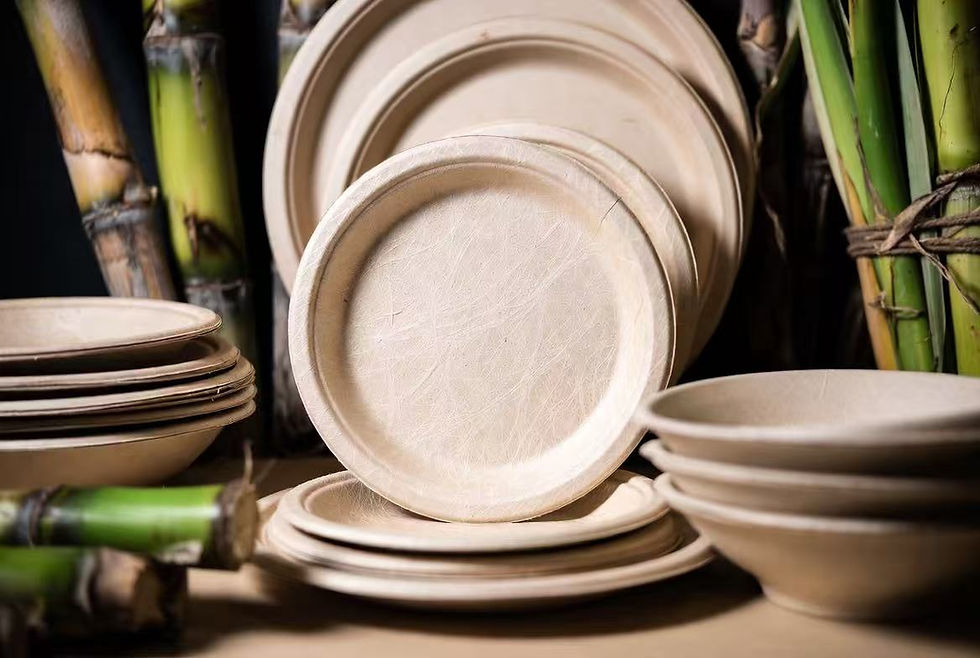
Why Sugarcane Bagasse Is Better Than “Biodegradable Plastics”
Many "biodegradable" plastics use special chemicals to make them crumble faster. Bagasse does not need these additives.
The core difference is this:
"Biodegradable" plastics just break into smaller pieces.
Bagasse actually breaks down completely.
Bagasse turns into nutrients for soil. "Biodegradable" plastics often just turn into smaller pollution.
For food packaging, where safety, waste, and the environment all meet, this difference is very important.
How Businesses and Consumers Can Avoid Greenwashing
To avoid being misled, look deeper than the words on the front of the package.
Make smart choices by:
Asking if it's "compostable," not just "biodegradable."
Looking for a trusted third-party certification seal.
Learning how your city's waste and compost systems work.
Choosing products from brands that are open about where their materials come from.
Real sustainability isn't about good marketing words—it's about results you can check and prove.
FAQ: Biodegradable, Compostable, and Sugarcane Bagasse Explained
Q: Is biodegradable packaging always good for the environment?
A: No. Many products labeled "biodegradable" just break into tiny plastic bits (microplastics) or take hundreds of years to decompose.
Q: Are all compostable products biodegradable?
A: Yes, but there's a big difference. "Compostable" means it meets strict rules to break down safely and completely in a composting facility.
Q: Can sugarcane bagasse packaging replace plastic?
A: For many food service needs, absolutely. It's an excellent replacement for single-use plastic plates, bowls, and food containers.
Q: Does bagasse break down in a home compost pile?
A: It works best in industrial facilities. However, even in a landfill, it is a natural plant material that is far safer for the planet than plastic.
Conclusion: Clear Labels, Better Choices, Real Sustainability
The difference between "biodegradable" and "compostable" is more than just a word choice. It decides whether a product actually helps the planet or secretly adds to the pollution problem.
As packaging changes, materials like sugarcane bagasse tableware show a clear and useful way forward. They bring together strength, safety, and care for the environment without using unclear promises or taking centuries to break down.
Clear, honest labels help us make better choices.Better choices lead to truly sustainable results.

Mark
Director at Mana-Eco
Specializing in biodegradable tableware
WhatsApp: +86 18858902211
Email:mark@mana-eco.com


Comments