
Sugarcane Products and Uses: Beyond Sugar to Sustainable Packaging

Sugarcane is one of the world’s most cultivated crops. Most people immediately think of sweetness—but the sugarcane plant yields a remarkable range of products and byproducts that extend far beyond table sugar. From biofuels and molasses to industrial fibers and eco-friendly packaging, sugarcane plays a vital role in global agriculture, energy, and materials innovation.
This article explores those diverse uses and highlights how forward-thinking manufacturers like MANA-ECO are transforming agricultural byproducts into sustainable solutions such as compostable tableware.

Introduction
Sugarcane cultivation has an ancient history, and its uses have evolved dramatically with technological advances. While refined sugar remains the most familiar product, other derivatives such as molasses, ethanol, animal feed, and forestry materials contribute significantly to economies worldwide. Importantly, the fibrous residue known as bagasse is emerging as a transformative raw material for sustainable packaging and high-value industrial applications.
The Sugarcane Plant: More Than Just Sugar
Sugarcane’s capacity to produce a wide range of products begins with its natural composition and harvesting process.
Primary Sugar Production
The most well-known product is refined sugar, which comes from sucrose extracted from sugarcane stalks. Sugar production involves mechanical juice extraction followed by purification and crystallization. The resulting sugar is used in countless food and beverage products worldwide.
Molasses, Panela, Jaggery and Other Sweet Products
Not all sugarcane products are fully refined. In many regions:
Molasses serves as a thick, mineral-rich syrup used in baking, fermentation, animal feed, and rum production.
Panela and jaggery are traditional unrefined sugars valued for flavor and nutrition in Latin America and Asia.
These products represent culturally significant and nutritionally distinct uses of sugarcane.
Ethanol and Bioenergy
Another major product is ethanol, created through fermentation of sugarcane juice or molasses. Unlike gasoline, sugarcane-derived ethanol is a renewable fuel source that lowers greenhouse gas emissions and plays a role in energy blending strategies worldwide.
Major Industrial Byproducts of Sugarcane
Significant value emerges not from the juice, but from what remains after extraction.
Bagasse – The Foundation of Sustainable Materials
Bagasse is the fibrous residue left after sugarcane juice extraction. Traditionally burned for energy in mills, bagasse is now recognized as a raw material for multiple uses, including:
Biofuel and power generation
Paper and cardboard production
Particle boards and building materials
Compostable packaging and dinnerware
For every ton of sugarcane processed, approximately 280 kg of dry bagasse is generated, offering a substantial resource for sustainable materials.
Filter Mud and Press Mud in Agriculture
The filtration process that refines cane juice yields a residue known as filter mud or press mud. Rich in organic matter, this byproduct is widely used as a natural fertilizer that improves soil quality and water retention in crop fields.
Vinasse and Other Residues
Vinasse is the liquid leftover from ethanol production and contains organic compounds valuable in animal feed or further fermentation for biogas. Other residues can be converted into valuable chemical precursors or energy products.
Bagasse Products: Transforming Waste into Value
Bagasse is central to modern innovations in sustainable materials.
Compostable Packaging and Tableware
Molded bagasse products—such as plates, bowls, clamshells, and trays—offer a biodegradable alternative to petroleum-based plastics. These items are:
Plastic-free and PFAS-free
Industrial compostable
Suitable for hot and cold food service
Strong and moisture resistant
Bagasse packaging leverages natural fibers to meet both performance and environmental goals.
Advanced Applications: Nanocellulose and Biocomposites
Cutting-edge research shows bagasse fibers can be transformed into nanocellulose, which possesses exceptional strength, optical clarity, and barrier properties. Such materials are suitable for advanced films, energy storage components, and high-performance composites.
In addition, bagasse can integrate with other biopolymers to create new bio-films for packaging that balance strength and biodegradability.
Structural Materials and Paper Products
Bagasse pulp is also an increasingly popular alternative to wood pulp for paperboard, cartons, and packaging board products. This application reduces deforestation pressure and promotes a circular economy.
Why Sugarcane Products Matter for Sustainability
Sugarcane’s renewability and diverse applications position it as a pillar of sustainable development.
Renewable Resource and Circular Economy
Sugarcane is a rapidly renewable plant harvested annually, and almost every part of its biomass can be repurposed—reducing waste and supporting circular material systems.
Carbon Footprint and Waste Reduction
Using byproducts like bagasse for compostable products helps divert materials from landfills and offsets carbon emissions, contributing to broader environmental goals.
MANA-ECO’s Role: From Bagasse to High-Performance Tableware

Manufacturing Expertise-compostable food packaging manufacturer
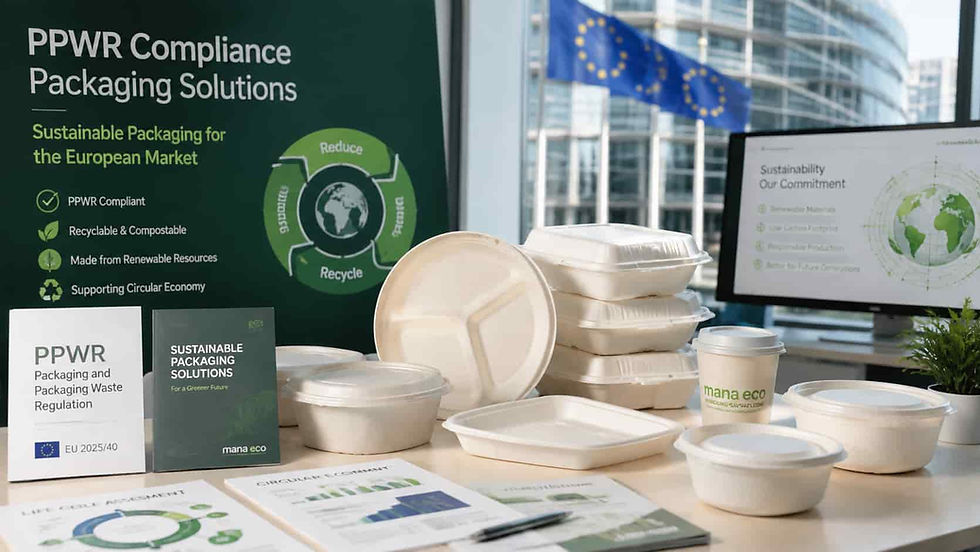
At MANA-ECO, we take sugarcane byproducts and transform them into high-quality, compostable tableware designed for food service, catering, and takeout applications. With advanced molded fiber production expertise and rigorous quality controls, our products perform reliably under real-world conditions.
Customization and Quality Control
We offer a wide range of bagasse bowls & containers—from bowls and trays to lids and clamshell containers—each built to meet diverse needs. Custom branding options let businesses elevate their packaging without compromising sustainability.
certified compostable standards and Industry Standards
MANA-ECO adheres to global food safety and environmental standards, ensuring products meet rigorous performance and compliance requirements.
FAQ: Sugarcane Products and Uses
Q1: What are the main sugarcane byproducts used industrially?
Sugarcane byproducts include bagasse (fibrous residue), molasses, filter mud, and vinasse, each with applications in energy, agriculture, and materials.
Q2: Is bagasse compostable?
Yes. Bagasse products such as molded plates and trays are industrially compostable and break down into organic matter.
Q3: Can bagasse be used for high-strength materials?
Yes. Nanocellulose and biocomposites from bagasse are used in advanced packaging and structural applications.
Q4: Are sugarcane products sustainable?
Most sugarcane byproducts can be repurposed or composted, reducing waste and supporting renewable material cycles.
Q5: How does MANA-ECO support sustainable packaging?
MANA-ECO manufactures compostable tableware from sugarcane bagasse with high performance and eco credentials.
Conclusion
Sugarcane products span from traditional sweeteners like sugar, molasses, and panela to cutting-edge sustainable materials such as compostable packaging and nanocellulose composites. By maximizing the value of every part of this versatile plant, industries can reduce waste, lower environmental impact, and support circular economy goals.
At the forefront of this evolution, MANA-ECO leverages sugarcane byproducts to deliver high-performance, compostable tableware solutions that meet modern food service needs—proving that agricultural residue can be a springboard for sustainability.



Comments