
Sugarcane Bagasse Tableware Factory: Manufacturing Process, Quality Control and Export Guide

Introduction

The global demand for sustainable packaging solutions continues to grow as companies explore alternatives within the circular economy.
For importers, distributors, and foodservice suppliers, choosing the right manufacturing partner is one of the most important decisions when sourcing compostable tableware.
A reliable sugarcane bagasse tableware factory should provide more than competitive pricing.
Professional buyers need suppliers with:
Stable production capacity
Advanced manufacturing equipment
Strict quality control
Consistent product performance
Reliable export capability
Sugarcane bagasse tableware has become one of the most widely adopted sustainable packaging solutions because it combines:
Renewable raw materials
Compostable characteristics
Good strength performance
Wide application possibilities
However, not every supplier has the same manufacturing capability.
Understanding how bagasse tableware is produced helps buyers evaluate suppliers more effectively.
This guide explains:
How sugarcane bagasse tableware is manufactured
Factory production processes
Quality control systems
Production capacity evaluation
How to choose a reliable supplier
What Is a Sugarcane Bagasse Tableware Factory?
A sugarcane bagasse tableware factory is a manufacturing facility that converts sugarcane fiber waste into molded fiber food packaging products.
Unlike trading companies, professional factories control the complete production process.
This allows manufacturers to provide:
Better production stability
More consistent quality
OEM development capability
Better supply chain management
Factory vs Trading Company: Why It Matters
Many buyers initially focus only on price.
However, working directly with a factory provides several advantages.
Production Control
Factories can directly manage:
Production schedules
Quality standards
Manufacturing improvements
Product Development Support
A real manufacturer can support:
New product development
Mold adjustment
Custom designs
Supply Stability
For long-term business growth, buyers need suppliers that can support increasing demand.
A factory with sufficient capacity can provide:
Regular production
Repeat orders
Market expansion support
Why Factory Capability Matters for Global Buyers?
When sourcing compostable tableware internationally, production capability directly affects business performance.
Stable Supply for Growing Markets
Distributors and importers need suppliers who can maintain stable availability.
Production problems can cause:
Shipment delays
Customer complaints
Lost market opportunities
Therefore, factory capacity should always be evaluated before cooperation.
Consistent Product Quality
Large-scale buyers require stable products.
Important factors include:
Product dimensions
Weight consistency
Strength performance
Appearance quality
Professional factories use standardized production processes to maintain consistency.
Support for OEM and Custom Projects
A capable factory should not only produce standard items.
It should also support:
Custom molds
New product structures
Private label projects
This is especially important for brands developing unique sustainable packaging solutions.
Complete Sugarcane Bagasse Tableware Manufacturing Process
Understanding the production process helps buyers evaluate supplier capability.
The manufacturing process includes:
Step 1: Raw Material Preparation
Sugarcane bagasse is collected after sugar production.
The fiber material is processed and prepared for pulp production.
The quality of raw materials directly influences:
Product strength
Appearance
Performance
Step 2: Pulp Processing
The bagasse fiber is processed into suitable pulp.
During this stage:
Fiber consistency is controlled
Material properties are adjusted
Production requirements are prepared
Step 3: Product Molding
The pulp is formed into different product shapes using specialized molding equipment.
Products include:
Plates
Bowls
Food containers
Trays
Cups
The molding process determines:
Product structure
Thickness
Appearance
Step 4: Drying and Finishing
After molding:
Products go through:
Drying
Edge trimming
Surface inspection
This improves:
Product appearance
Usability
Packaging quality
Step 5: Quality Inspection
Before shipment:
Products are checked for:
Size
Weight
Appearance
Quantity
Only approved products proceed to packaging.
How Sugarcane Bagasse Tableware Is Manufactured
Understanding the manufacturing process helps global buyers evaluate whether a supplier has professional production capability.
Although sugarcane bagasse tableware looks simple, producing consistent and reliable products requires multiple controlled processes.
A professional molded fiber manufacturing process usually includes:
Raw Material Preparation
The production process starts with sugarcane bagasse, a natural fiber material left after sugarcane juice extraction.
Before production, the material needs to be:
Collected
Cleaned
Processed
Prepared for pulp production
The quality of raw materials directly affects:
Product strength
Surface appearance
Manufacturing consistency
A reliable factory should have stable raw material management to ensure consistent product performance.
Fiber Processing and Pulp Preparation
After preparation, sugarcane bagasse fibers are processed into suitable pulp.
During this stage, manufacturers control:
Fiber structure
Pulp consistency
Material performance
The goal is to create pulp with suitable characteristics for molding different products.
Different products may require different material adjustments.
For example:
Plates require good rigidity
Food containers require stronger structure
Cups require better dimensional stability
Mold Forming Process
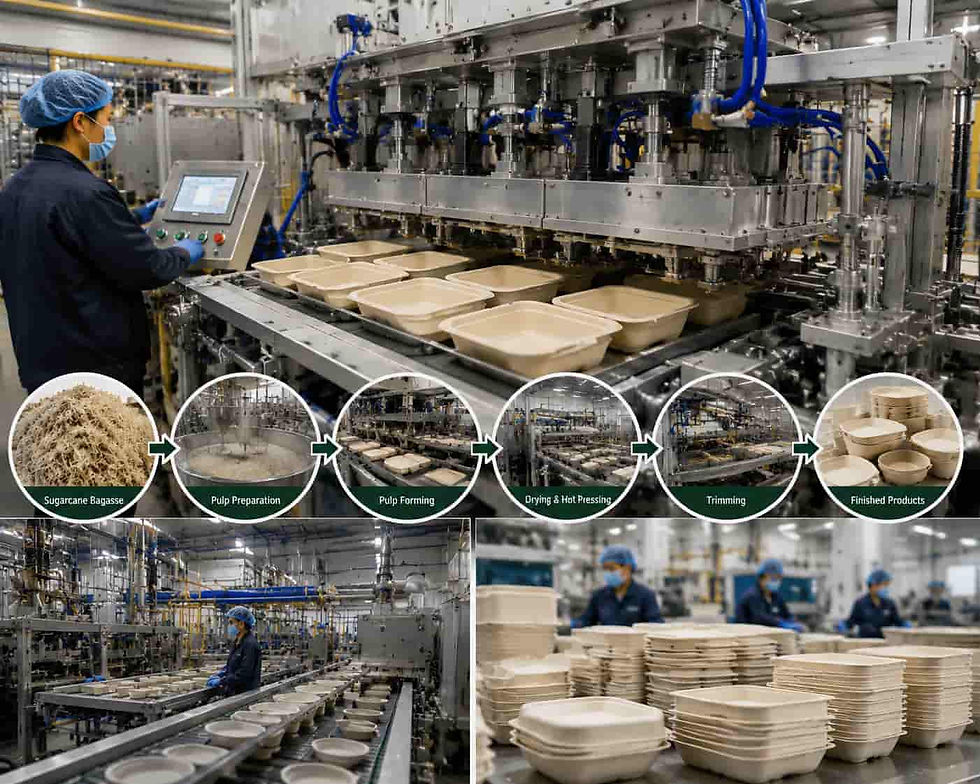
Molding is one of the most important steps in bagasse tableware manufacturing.
During this process, pulp material is formed into specific product shapes using customized molds.
Products can include:
Plates
Bowls
Clamshell containers
Food trays
Cups
The molding process determines:
Product shape
Wall thickness
Surface quality
Structural performance
For OEM projects, customized molds allow brands to develop unique product designs for their target markets.
Drying and Surface Finishing
After molding, products need further processing.
Common finishing processes include:
Drying
Edge trimming
Surface inspection
These processes help improve:
Product appearance
Packaging quality
User experience
A professional manufacturing process should minimize:
Uneven edges
Surface defects
Product deformation
Quality Inspection Before Shipment
Quality control is an essential part of international supply.
Before shipment, manufacturers usually inspect:
Appearance
Checking:
Cracks
Deformation
Surface defects
Color consistency
Dimensions
Checking:
Product size
Shape accuracy
Weight consistency
Functional Performance
Depending on product requirements, factories may evaluate:
Leakage resistance
Heat resistance
Stacking performance
Product durability
For global buyers, consistent quality is often more important than the lowest price.
[Image 2 Insert Here]
Image:
Sugarcane Bagasse Tableware Production Process
Purpose:
展示:
Raw material → pulp → molding → finished products
Quality Control Standards for Export Bagasse Tableware
For international buyers, quality management is one of the most important supplier evaluation factors.
A reliable sugarcane bagasse tableware factory should have quality control throughout the entire production process.
Incoming Material Inspection
Before production begins, raw materials should be checked.
Important factors include:
Material cleanliness
Fiber quality
Production suitability
Stable raw materials help ensure stable finished products.
Production Process Control
During manufacturing, factories should monitor:
Production parameters
Product consistency
Machine operation
Continuous monitoring helps reduce:
Production variation
Defective products
Delivery problems
Finished Product Inspection
Before products leave the factory, final inspection should include:
Quantity Check
Ensuring:
Correct order quantity
Correct packaging quantity
Packaging Check
Ensuring:
Carton condition
Product protection
Correct labels
Shipment Preparation
Ensuring:
Export documents
Shipping marks
Container loading requirements
What Global Buyers Should Check Before Choosing a Bagasse Tableware Factory
Choosing a supplier requires more than comparing prices.
Professional buyers should evaluate several important factors.
Is the Supplier a Real Manufacturer?
One of the first questions buyers should ask:
Are you a manufacturer or a trading company?
A direct factory usually provides:
Better production communication
Faster technical response
More customization options
Can the Supplier Support OEM Projects?
If you plan to build your own brand, check whether the supplier can provide:
Product customization
Mold development
Prototype samples
Packaging solutions
OEM capability is especially important for:
Brand owners
Distributors
Retail suppliers
Does the Supplier Understand Export Requirements?
International business requires more than production.
A qualified export supplier should understand:
International packaging requirements
Shipping documents
Container loading
Market regulations
For businesses looking for customized products, choosing a supplier with OEM development capability is essential.
Can the Supplier Provide Product Information?
Professional suppliers should be able to provide:
Product specifications
Material information
Certification documents
Sample support
Clear product information helps buyers evaluate cooperation more efficiently.
Export Process for Sugarcane Bagasse Tableware
For international buyers, understanding the export process helps avoid communication problems.
A typical export workflow includes:
Step 1: Product Confirmation
Buyer and supplier confirm:
Product models
Specifications
Packaging requirements
Order quantity
Step 2: Production Arrangement
After order confirmation:
The factory prepares:
Raw materials
Production schedule
Quality inspection plan
Step 3: Packaging Preparation
Products are packed according to export requirements.
Packaging usually includes:
Inner packaging
Export cartons
Product labels
Step 4: Shipment Arrangement
Depending on buyer requirements, shipments may use:
Full container load (FCL)
Less than container load (LCL)
Common trade terms include:
FOB
CIF
EXW
How to Choose a Reliable Sugarcane Bagasse Tableware Factory?
Selecting the right manufacturing partner is one of the most important decisions for importers and distributors.
A supplier should not only provide products but also support long-term business development.
When evaluating a sugarcane bagasse tableware factory, buyers should consider the following factors.
Manufacturing Experience and Product Knowledge
A professional manufacturer should understand:
Material characteristics
Product design requirements
Production limitations
Market applications
Experience allows suppliers to provide better recommendations during product selection and customization.
For example:
A manufacturer with experience in foodservice packaging can help buyers choose suitable:
Product structures
Sizes
Applications
Product Range and Development Capability
A supplier with a wider product capability can support business expansion.
Buyers may look for manufacturers that can provide:
Plates
Bowls
Food containers
Trays
Cups
Customized molded fiber products
A broader product range allows importers and distributors to build complete sustainable packaging solutions.
Communication and Technical Support
International sourcing requires effective communication.
A reliable supplier should provide:
Clear product information
Fast technical responses
Professional sample support
Production updates
Good communication reduces risks during:
Product development
Order confirmation
Mass production
Quality Consistency and Long-Term Cooperation
For businesses selling sustainable packaging products, consistency is critical.
A good supplier relationship should help buyers achieve:
Stable product quality
Reliable delivery
Continuous improvement
The goal is not only one successful order but a long-term supply partnership.
Why Choose MANA ECO as Your Sugarcane Bagasse Tableware Supplier?

Choosing a reliable manufacturer is essential for companies developing sustainable packaging businesses.
MANA ECO specializes in sugarcane bagasse tableware manufacturing and provides solutions for global customers. Learn more about our manufacturing capabilities and production solutions.
Importers
Distributors
Foodservice suppliers
Sustainable packaging brands
Complete Product Manufacturing Solutions
MANA ECO supports customers with:
Standard bagasse tableware products
Customized product development
OEM manufacturing solutions
Private label support
From product selection to customized projects, customers can work with one professional manufacturing partner.
Focus on Sustainable Packaging Applications
Sugarcane bagasse products are widely used in:
Restaurants
Catering businesses
Food delivery
Retail food packaging
Institutional foodservice
MANA ECO works with customers to develop suitable packaging solutions for different market applications.
Supporting Global B2B Buyers
For international customers, successful cooperation requires more than product supply.
MANA ECO focuses on:
Professional communication
Stable manufacturing support
Product customization
Long-term partnership
Whether customers need standard products or customized solutions, the goal is to provide reliable sustainable packaging manufacturing support.
Frequently Asked Questions About Sugarcane Bagasse Tableware Factories
Q1: What is a sugarcane bagasse tableware factory?
A sugarcane bagasse tableware factory is a manufacturing facility that converts sugarcane fiber into compostable molded fiber products such as plates, bowls, food containers, and trays.
Q2: How is sugarcane bagasse tableware manufactured?
The manufacturing process usually includes:
Raw material preparation
Fiber processing
Pulp preparation
Mold forming
Drying
Quality inspection
Packaging
Q3: What should buyers check before choosing a bagasse tableware supplier?
Buyers should evaluate:
Manufacturing capability
Product quality control
OEM ability
Export experience
Communication efficiency
Q4: Can bagasse tableware factories provide customized products?
Yes.
Professional manufacturers can support:
Custom designs
Customized molds
Product development
Private label packaging
Q5: What products can be manufactured from sugarcane bagasse?
Common products include:
Plates
Bowls
Clamshell containers
Food trays
Cups
Custom molded fiber packaging
Q6: How do buyers import bagasse tableware internationally?
The general process includes:
Product selection
Sample confirmation
Order placement
Production
Quality inspection
Shipment arrangement
Q7: Why choose sugarcane bagasse instead of traditional plastic packaging?
Sugarcane bagasse provides a renewable fiber-based alternative for businesses seeking more sustainable packaging options.
It is widely used in foodservice and takeaway applications.
Conclusion: Choosing the Right Bagasse Tableware Factory
The global sustainable packaging market continues to expand, creating new opportunities for importers, distributors, and brands.
However, choosing the right manufacturing partner is essential for long-term success.
A professional sugarcane bagasse tableware factory should provide:
Reliable manufacturing capability
Consistent quality management
Product development support
Export experience
Long-term cooperation value
Understanding the manufacturing process and supplier evaluation criteria helps buyers make better sourcing decisions.
MANA ECO supports global businesses with sugarcane bagasse tableware manufacturing solutions, helping customers develop reliable and sustainable packaging product lines.


Comments