
OEM Compostable Tableware Manufacturer: Complete Guide for Private Label Packaging Buyers

Introduction
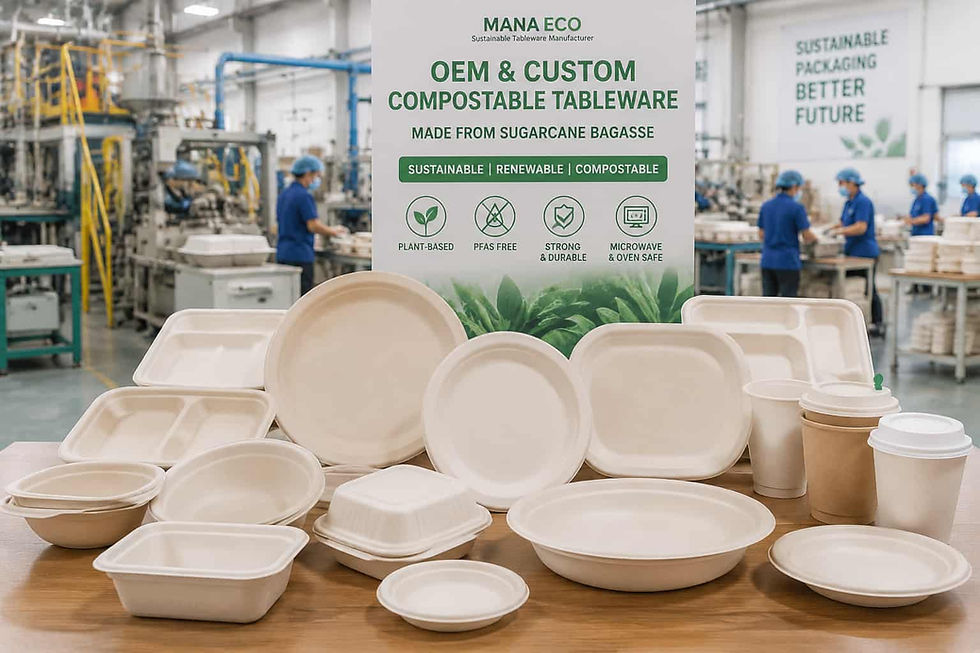
The sustainable packaging industry is experiencing rapid growth as businesses worldwide search for alternatives to traditional plastic disposable products.
For many companies, simply purchasing standard products is no longer enough.
Importers, distributors, restaurant supply companies, and sustainable packaging brands increasingly require:
Customized product designs
Private label solutions
Unique packaging
Reliable manufacturing partners
This has created growing demand for professional OEM compostable tableware manufacturers.
An experienced OEM supplier can help businesses transform product ideas into commercial products through:
Product development
Custom mold design
Prototype production
Mass manufacturing
Private label packaging
Among sustainable materials, sugarcane bagasse has become one of the most popular choices for customized compostable tableware.
Made from renewable sugarcane fiber, bagasse can be manufactured into:
Plates
Bowls
Food containers
Meal trays
Cups
Custom molded fiber products
For businesses entering the sustainable packaging market, choosing the right OEM manufacturing partner is essential.
This guide explains:
How OEM compostable tableware manufacturing works
What customization options are available
How mold development works
MOQ and production requirements
How to select a reliable supplier
What Is OEM Compostable Tableware Manufacturing?
OEM manufacturing allows businesses to create differentiated products for their own markets. Professional suppliers can provide complete OEM compostable packaging solutions, from product development and mold creation to mass production.
In the compostable tableware industry, OEM manufacturing allows companies to develop products based on:
Their own designs
Market requirements
Brand positioning
Customer preferences
Instead of selling only standard products, OEM buyers can create differentiated products for their own markets.
OEM vs Standard Tableware Products
Standard products:
Existing molds
Fixed sizes
Limited customization
OEM products:
Customized designs
Custom molds
Brand packaging
Special structures
For distributors and private brands, OEM manufacturing provides more control over product positioning.
Why OEM Is Important for Sustainable Packaging Brands
The sustainable packaging market is becoming increasingly competitive.
Companies need ways to differentiate themselves.
OEM solutions help businesses create:
Unique product lines
Better brand recognition
Market-specific solutions
For example:
A restaurant supply company may need:
Custom tray sizes
A supermarket brand may need:
Private label packaging
A distributor may need:
Exclusive product designs
Why Businesses Choose Private Label Compostable Tableware?
Private label products allow companies to sell sustainable tableware under their own brand names.
This business model is widely used by:
Packaging distributors
Retail brands
Restaurant suppliers
E-commerce companies
Build Brand Differentiation
When companies sell only generic products, competition is mainly based on price.
Private label products allow businesses to compete through:
Product uniqueness
Brand value
Customer loyalty
Control Product Positioning
With private label manufacturing, buyers can decide:
Product design
Packaging style
Brand message
Target market
This is especially valuable for companies developing sustainable product categories.
Create Long-Term Supply Partnerships
A professional OEM manufacturer can become a long-term production partner.
Instead of constantly searching for suppliers, businesses can establish:
Stable production schedules
Consistent product quality
Continuous product development
Types of Compostable Tableware Available for OEM Production
A professional OEM compostable tableware manufacturer should be able to support different product categories according to customer market requirements.
For importers and private label brands, choosing a manufacturer with a complete product range provides several advantages:
One-stop sourcing
Consistent quality management
Easier product expansion
Lower supplier management costs
MANA ECO provides OEM manufacturing solutions for a wide range of sugarcane bagasse tableware products, including:
Plates
Bowls
Clamshell containers
Food trays
Cups
Cutlery
OEM Bagasse Plates
Bagasse plates are one of the most popular products in the compostable tableware market.
OEM customization options include:
Different sizes
Different shapes
Section designs
Customized structures
Common applications:
Restaurants
Catering companies
Foodservice distributors
Event suppliers
For private label brands, customized plates help create differentiated sustainable product lines.
OEM Bagasse Bowls
Bagasse bowls are widely used for:
Soups
Salads
Rice dishes
Desserts
Takeaway meals
OEM options include:
Capacity customization
Shape adjustment
Packaging customization
Brand labeling
OEM Clamshell Food Containers
Clamshell containers are widely used in takeaway and food delivery markets.
Businesses often require customized solutions based on:
Food portions
Transportation requirements
Market preferences
OEM development can include:
Different compartment designs
Customized sizes
Special structures
Custom Molded Fiber Food Trays
Food trays are another important category for OEM projects.
Applications include:
Ready meals
Frozen food packaging
Catering products
Retail food packaging
Customized trays can be developed according to:
Product dimensions
Food applications
Brand requirements
Custom Sugarcane Bagasse Products
Beyond standard products, professional manufacturers can develop new products according to customer requirements.
Examples:
Special-shaped containers
Customized meal boxes
Unique packaging structures
This capability allows companies to create products specifically designed for their target markets.
OEM Manufacturing Process From Design to Mass Production
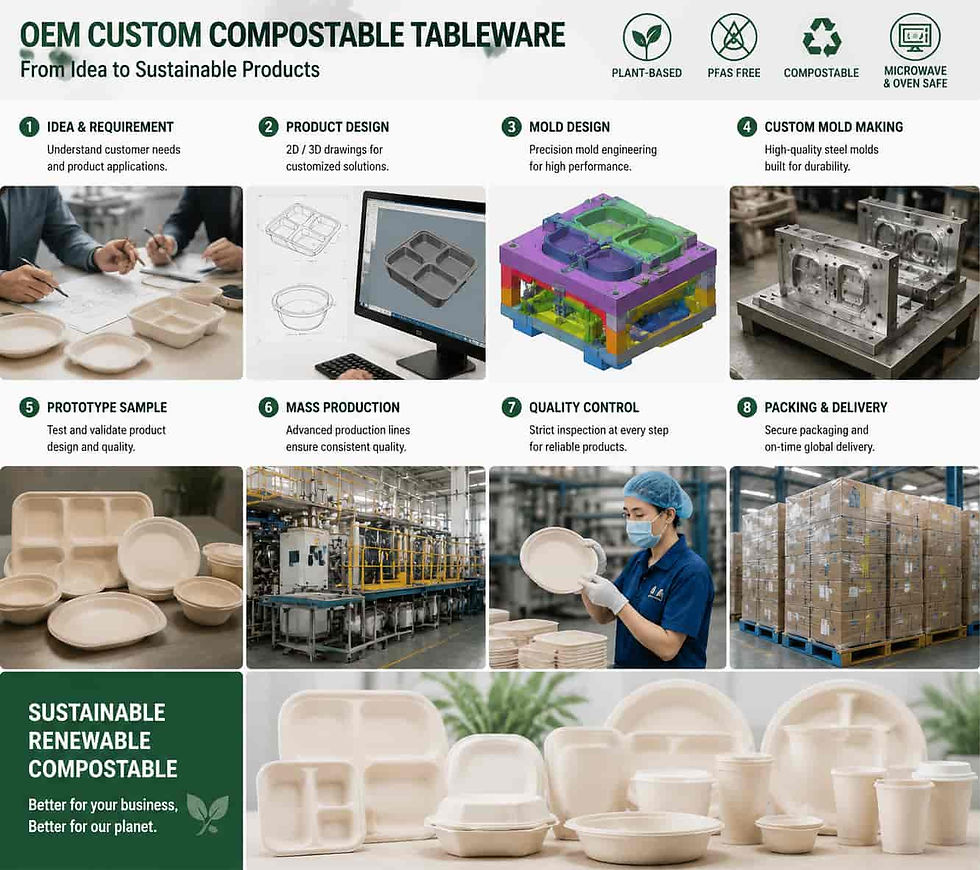
A professional OEM manufacturer should have a complete product development process.
A reliable process reduces risks and helps customers move from concept to commercial production efficiently.
The typical OEM workflow includes:
Step 1: Product Requirement Discussion
The process begins with understanding customer requirements.
Information usually includes:
Product type
Size
Capacity
Application
Quantity requirement
Target market
Customers may provide:
Product drawings
Reference samples
Market specifications
Step 2: Product Design Evaluation
After receiving requirements, the manufacturer evaluates:
Production feasibility
Mold structure
Material performance
Manufacturing requirements
This stage helps determine whether the product can be produced efficiently.
Step 3: Prototype and Sample Development
Before mass production, customers usually need samples for evaluation.
MANA ECO provides:
Sample mold + prototype sample service
Price:
USD 1,000 per set
This service allows customers to confirm:
Product appearance
Size accuracy
Practical application
Market suitability
Step 4: Production Mold Development
After sample approval, production molds can be developed.
The mold design depends on:
Product complexity
Product size
Structure requirements
Manufacturing technology
For reference:
Customized production mold cost:
Approximately USD 15,000–20,000 per set
The final mold cost depends on the specific product design.
Step 5: Mass Production
After:
Mold approval
Order confirmation
Deposit payment
The manufacturer begins production.
MANA ECO standard production lead time:
Approximately 30 days after order confirmation and deposit received.
Step 6: Quality Inspection and Shipment
Before shipment, products are inspected for:
Appearance
Dimensions
Quantity
Packaging quality
After approval, products are prepared for export shipment.
Custom Mold Development for Compostable Tableware
Custom molds are one of the most important parts of OEM manufacturing.
A mold determines:
Product shape
Size
Structure
Production efficiency
For companies creating unique sustainable packaging products, customized molds provide a competitive advantage.
Why Custom Molds Matter
Standard products are limited by existing designs.
Custom molds allow businesses to create:
Unique products
Exclusive designs
Market-specific solutions
For example:
A meal delivery company may require:
Special compartment trays
A retail brand may require:
Unique packaging shapes
A food manufacturer may require:
Specific product dimensions
OEM Mold Investment Considerations
Before developing a custom mold, buyers should evaluate:
Market Demand
Custom molds require investment.
Businesses should ensure:
Stable market demand
Long-term sales potential
Production Quantity
OEM projects are usually suitable for:
Importers
Distributors
Brands
because higher volumes can spread mold investment costs.
Product Lifecycle
A successful OEM product should have:
Long-term market value
Repeat order potential

Private Label Packaging and Branding Solutions
Private label manufacturing is not only about producing products.
It also includes creating a complete branded packaging solution.
Professional suppliers can support:
Product customization
Packaging design
Logo printing
Carton customization
Logo Printing Customization
For customers requiring brand identification, logo printing can be added.
Example:
Small-area product printing:
USD 0.018 per piece
Suitable for:
Brand logos
Simple graphics
Product identification
Custom Carton Packaging
Outer carton customization is also available.
For customized carton logo printing:
Free of charge
This helps brands improve product recognition while controlling packaging costs.
Private Label Supply Chain Support
A professional OEM partner should support the complete supply chain:
From:
Product idea
↓
Prototype
↓
Production
↓
Packaging
↓
Export shipment
This allows brands to focus on:
Marketing
Sales channels
Customer development
while the manufacturer manages production.
How to Choose the Right OEM Compostable Tableware Manufacturer?
Choosing the right OEM partner is one of the most important decisions for businesses entering the sustainable packaging market.
A professional supplier should not only provide competitive pricing but also offer:
Manufacturing capability
Product development experience
Quality management
Stable supply capacity
Long-term cooperation support
Many companies make the mistake of choosing suppliers only based on price.
However, OEM manufacturing requires deeper evaluation.
Evaluate Manufacturing Capability
The first consideration is whether the supplier has real manufacturing capability.
A reliable OEM compostable tableware manufacturer should have:
Production facilities
Professional equipment
Experienced technical teams
Quality control processes
This ensures the supplier can support:
Trial projects
Large-volume orders
Long-term supply programs
Evaluate OEM Development Experience
OEM manufacturing requires more than production.
A capable supplier should understand:
Product design
Mold development
Material performance
Manufacturing limitations
Experienced manufacturers can help customers avoid:
Unrealistic designs
Production problems
Excessive development costs
Evaluate Production Capacity
For distributors and private label brands, production capacity directly affects business growth.
A supplier should be able to support:
Increasing order volume
Multiple product categories
Continuous supply
MANA ECO operates professional sugarcane bagasse tableware production facilities.
Factory capability includes:
Production Lines
MANA ECO has:
10 production lines
Machine Configuration
Each production line includes:
10 production machines
Total:
100 production machines
Production Capacity Example
Using disposable plates as an example:
Each machine produces approximately:
800 kg of finished products per day
This production capability enables MANA ECO to support:
Wholesale distributors
Foodservice suppliers
Import companies
Private label brands
Evaluate Quality Management
A reliable OEM supplier should have quality control throughout production.
Important quality checkpoints include:
Raw Material Inspection
Checking:
Fiber quality
Material consistency
Production suitability
Production Monitoring
Checking:
Product dimensions
Weight consistency
Product structure
Final Product Inspection
Before shipment:
Appearance inspection
Quantity confirmation
Packaging inspection
A complete quality system helps maintain stable product performance.
MOQ, Cost and Lead Time for OEM Projects
Before starting an OEM project, buyers should understand production requirements.
Clear expectations help create efficient cooperation.
OEM Minimum Order Quantity (MOQ)
MOQ depends on whether products are standard or customized.
Standard Products
For existing bagasse tableware products:
Minimum order quantity:
100,000 pieces per SKU
This quantity helps manufacturers maintain:
Production efficiency
Stable quality
Competitive pricing
Customized OEM Products
For new customized products:
Minimum requirement:
One 20-foot container
Customized projects require additional preparation:
Mold development
Production setup
Packaging preparation
Quality approval
Therefore, container-level orders are recommended for OEM projects.
OEM Production Cost Factors
The total OEM cost depends on several factors:
Product Design
Complex designs may require:
More complicated molds
Longer development time
Mold Investment
Custom molds represent the largest initial investment.
Reference:
Production mold:
USD 15,000–20,000 per set
Printing and Packaging
Brand customization costs depend on:
Printing area
Design complexity
Packaging requirements
Example:
Small-area logo printing:
USD 0.018 per piece
Carton logo customization:
Free of charge
OEM Production Lead Time
After:
Product specifications confirmed
Order approved
Deposit received
Standard production time:
Approximately 30 days
For customized projects, additional time may be required for:
Mold development
Sample approval
Product testing
Why Choose MANA ECO as Your OEM Partner?

Finding a reliable OEM manufacturing partner is essential for sustainable packaging businesses.
MANA ECO provides complete sugarcane bagasse tableware manufacturing solutions for global customers.
Contact our team to discuss your customized compostable tableware project and receive a professional manufacturing evaluation.
Complete OEM Development Support
MANA ECO supports customers from product concept to mass production.
Services include:
✔ Product design evaluation✔ Custom mold development✔ Prototype samples✔ Production manufacturing✔ Private label packaging✔ Bulk export supply
Strong Manufacturing Capability
With:
10 production lines
100 production machines
Professional molding equipment
MANA ECO supports customers requiring:
Stable supply
Large-volume production
Multiple product categories
Flexible Customization Solutions
MANA ECO works with customers to develop:
Customized products
Brand packaging
Market-specific solutions
This helps importers and distributors build their own sustainable packaging product portfolios.
Long-Term Partnership Approach
A successful OEM relationship requires more than manufacturing.
It requires:
Communication
Production reliability
Technical support
Continuous improvement
MANA ECO focuses on becoming a long-term manufacturing partner for global sustainable packaging businesses.
Frequently Asked Questions About OEM Compostable Tableware Manufacturing
1. What does OEM compostable tableware manufacturing mean?
OEM compostable tableware manufacturing means a factory produces sustainable tableware according to a customer's requirements, including customized designs, molds, packaging, and branding.
2. Can I create my own bagasse tableware design?
Yes.
OEM manufacturers can develop products based on:
Drawings
Reference samples
Product concepts
Market requirements
3. How much does a custom bagasse tableware mold cost?
The cost depends on product complexity.
Reference:
A production mold usually costs approximately:
USD 15,000–20,000 per set.
4. What is the MOQ for OEM compostable tableware?
For standard products:
100,000 pieces per SKU.
For customized products:
Minimum one 20-foot container.
5. How long does OEM production take?
Standard production lead time:
Approximately:
30 days after order confirmation and deposit received.
6. Can OEM suppliers provide private label packaging?
Yes.
Private label services may include:
Logo printing
Customized cartons
Product packaging solutions
7. Why choose sugarcane bagasse for OEM products?
Sugarcane bagasse offers:
Renewable fiber material
Sustainable packaging advantages
Flexible molding capability
Wide foodservice applications
Conclusion: Building Sustainable Brands Through OEM Manufacturing
The demand for compostable packaging continues to grow as businesses worldwide move toward more sustainable solutions.
For companies entering this market, choosing the right OEM compostable tableware manufacturer is critical.
A reliable manufacturing partner should provide:
Product development capability
Custom mold solutions
Stable production capacity
Quality management
Private label support
MANA ECO helps global importers, distributors, and sustainable packaging brands develop customized sugarcane bagasse tableware products through professional OEM manufacturing solutions.
From prototype development to bulk production, MANA ECO supports businesses building long-term sustainable packaging brands.


Comments