
Compostable Bagasse Tableware Manufacturer: Complete Guide to OEM Production

Introduction:Compostable Bagasse Tableware Manufacturer

The global demand for sustainable food packaging is growing rapidly as businesses search for alternatives to traditional plastic disposable products.
Restaurants, catering companies, supermarkets, distributors, and foodservice suppliers are increasingly choosing compostable tableware solutions to meet environmental requirements and customer expectations.
Among different sustainable packaging materials, sugarcane bagasse tableware has become one of the most widely adopted solutions.
Made from renewable sugarcane fiber, bagasse tableware provides a practical combination of:
Sustainability
Product performance
Manufacturing flexibility
Commercial scalability
For companies purchasing disposable tableware in bulk, selecting the right compostable bagasse tableware manufacturer is critical.
A reliable manufacturer should provide more than finished products.
They should offer:
Professional production capability
Stable supply capacity
OEM customization
Private label solutions
Quality management
Export experience
This guide explains everything global buyers need to know about working with a professional sugarcane bagasse tableware manufacturer, including:
Product categories
Manufacturing process
OEM development
Factory capability
Certifications
Ordering requirements
Whether you are an importer, distributor, or sustainable packaging brand, this guide will help you understand how to select the right manufacturing partner.
What Is Compostable Bagasse Tableware?
Compostable bagasse tableware is disposable food packaging made from sugarcane fiber.
The raw material comes from sugarcane bagasse, the natural fiber residue left after extracting sugarcane juice.Sugarcane bagasse is an agricultural by-product generated during sugar production and is increasingly used in sustainable material applications.
Instead of being discarded, this agricultural by-product can be processed into molded fiber products.
Common bagasse tableware products include:
Plates
Bowls
Food containers
Meal trays
Cups
Cutlery
Through advanced pulp molding technology, sugarcane fiber can be transformed into durable foodservice products suitable for commercial applications.
Why Sugarcane Bagasse Is Used for Tableware Production
Sugarcane bagasse has several advantages as a packaging material.
Renewable Raw Material
Sugarcane is a renewable agricultural resource.
Using bagasse creates additional value from existing agricultural materials.
Reduced Plastic Dependency
Many companies are looking for alternatives to petroleum-based packaging.
Bagasse tableware provides a plant-based option for businesses reducing plastic usage.
Suitable for Large-Scale Manufacturing
Bagasse can be processed through industrial molding systems, making it suitable for:
Wholesale supply
OEM manufacturing
Large commercial orders
Common Applications of Compostable Bagasse Tableware
Bagasse products are widely used in:
Foodservice Industry
Including:
Restaurants
Cafes
Catering companies
Takeaway businesses
Retail Food Packaging
Including:
Supermarkets
Ready meal brands
Food manufacturers
Events and Hospitality
Including:
Hotels
Conferences
Outdoor events
Why Choose a Professional Bagasse Tableware Manufacturer?
For international buyers, choosing a supplier is a long-term business decision.
A professional manufacturer provides advantages beyond product supply.
Stable Production Capacity
Large distributors need suppliers that can support consistent volume requirements.
A professional manufacturer should have:
Production equipment
Skilled workers
Manufacturing systems
Quality control processes
Without sufficient production capability, suppliers may struggle with:
Delivery delays
Quality fluctuations
Large orders
Better Product Consistency
Working directly with a manufacturer helps maintain:
Product dimensions
Weight consistency
Packaging standards
Production stability
This is especially important for:
Supermarket suppliers
Restaurant chains
International distributors
Stronger OEM Capability
Many businesses need customized sustainable packaging products.
A professional manufacturer can provide:
Custom molds
Product development
Private label packaging
Logo customization
This allows companies to create unique products for their own markets.
Better Supply Chain Control
Direct cooperation with manufacturers provides:
Faster communication
Better production planning
More transparent cooperation
For long-term buyers, manufacturing capability is often more important than short-term price differences.
Complete Product Range of Sugarcane Bagasse Tableware
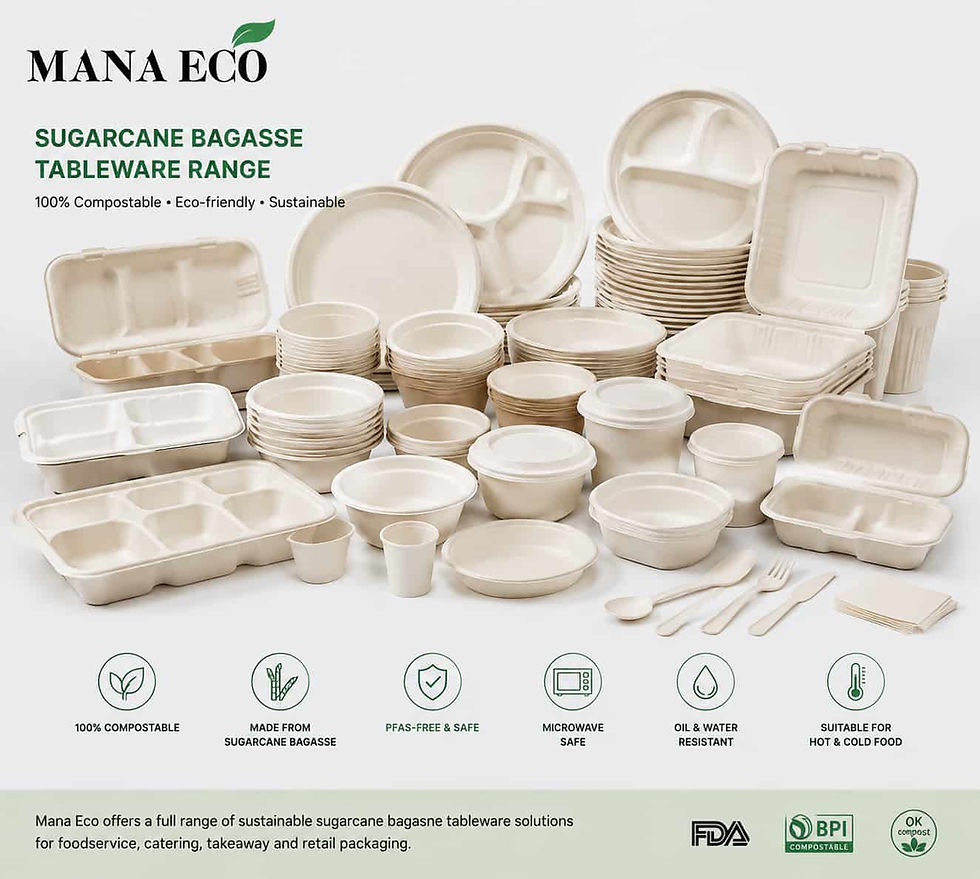
A professional sugarcane bagasse tableware manufacturer should provide a complete product portfolio to support different customer markets.
Global buyers usually prefer suppliers that can provide multiple product categories because it simplifies:
Supplier management
Product development
Purchasing processes
Logistics coordination
MANA ECO focuses on manufacturing a complete range of sugarcane bagasse tableware products, including plates, bowls, food containers, meal trays, cups, and cutlery for global foodservice and packaging businesses.
Bowls
Food containers
Meal trays
Cups
Cutlery
Bagasse Plates
Sugarcane bagasse plates are one of the most common compostable tableware products.
Available options include:
Round plates
Square plates
Section plates
Different diameter sizes
Common applications:
Restaurants
Catering services
Events
Foodservice distributors
For wholesale buyers, bagasse plates are attractive because they have:
High market demand
Wide application range
Stable purchasing frequency
Bagasse Bowls
Bagasse bowls are widely used for:
Soups
Rice dishes
Salads
Desserts
Takeaway meals
Buyers usually evaluate:
Bowl capacity
Structure strength
Leak resistance
Stacking efficiency
For distributors, bowls are an important category because they serve multiple food applications.
Bagasse Clamshell Food Containers
Clamshell containers are popular in takeaway and delivery markets.
They are commonly used for:
Fast food
Burgers
Sandwiches
Meal packaging
Advantages:
Integrated lid design
Easy transportation
Convenient food presentation
For food delivery businesses, clamshell containers provide a practical replacement for traditional plastic packaging.
Bagasse Food Trays
Bagasse food trays are widely used for:
Ready meals
Catering
Food preparation
Retail packaging
Common designs include:
Single compartment trays
Multi-compartment meal trays
Custom tray designs
Large food companies often prefer working with manufacturers that can provide customized tray solutions.
Bagasse Cups and Cutlery
Beyond plates and containers, professional bagasse manufacturers may also provide:
Cups
Lids
Spoons
Forks
Knives
A complete product range allows distributors to build a full sustainable tableware product portfolio.
How to Evaluate a Bagasse Tableware Supplier?
Selecting the right supplier is one of the most important decisions for importers and distributors.
A low price does not always mean a reliable supplier.
Professional buyers should evaluate suppliers from several aspects.
Manufacturing Experience
The first question buyers should ask:
"Is this company a real manufacturer?"
A professional bagasse tableware supplier should have:
Manufacturing facilities
Production equipment
Engineering capability
Quality management systems
Working directly with a factory provides:
Better production control
Faster communication
More stable supply
Production Capacity
For bulk buyers, production capacity directly affects supply reliability.
A supplier should be able to support:
Large volume orders
Multiple SKUs
Continuous supply requirements
MANA ECO operates professional sugarcane bagasse tableware production facilities.
Factory production capability includes:
Production Lines
10 production lines
Equipment Configuration
Each production line includes:
10 production machines
Total:
100 production machines
Taking disposable plates as an example:
Each machine can produce approximately:
800 kg of finished products per day
This production capacity enables MANA ECO to support:
International importers
Packaging distributors
Restaurant supply companies
OEM customers
Quality Control Capability
A reliable manufacturer should have quality control throughout the entire production process.
Raw Material Control
Checking:
Sugarcane fiber quality
Material consistency
Production suitability
Production Process Control
Monitoring:
Product dimensions
Weight
Shape accuracy
Surface quality
Final Inspection
Before shipment:
Products are checked for:
Appearance
Packaging
Quantity accuracy
Export Experience
International buyers need suppliers that understand export requirements.
Experienced manufacturers should support:
Export packaging
Documentation
Container loading
Shipping coordination
A supplier with export experience can reduce communication problems and delivery risks.
OEM and Private Label Bagasse Tableware Manufacturing
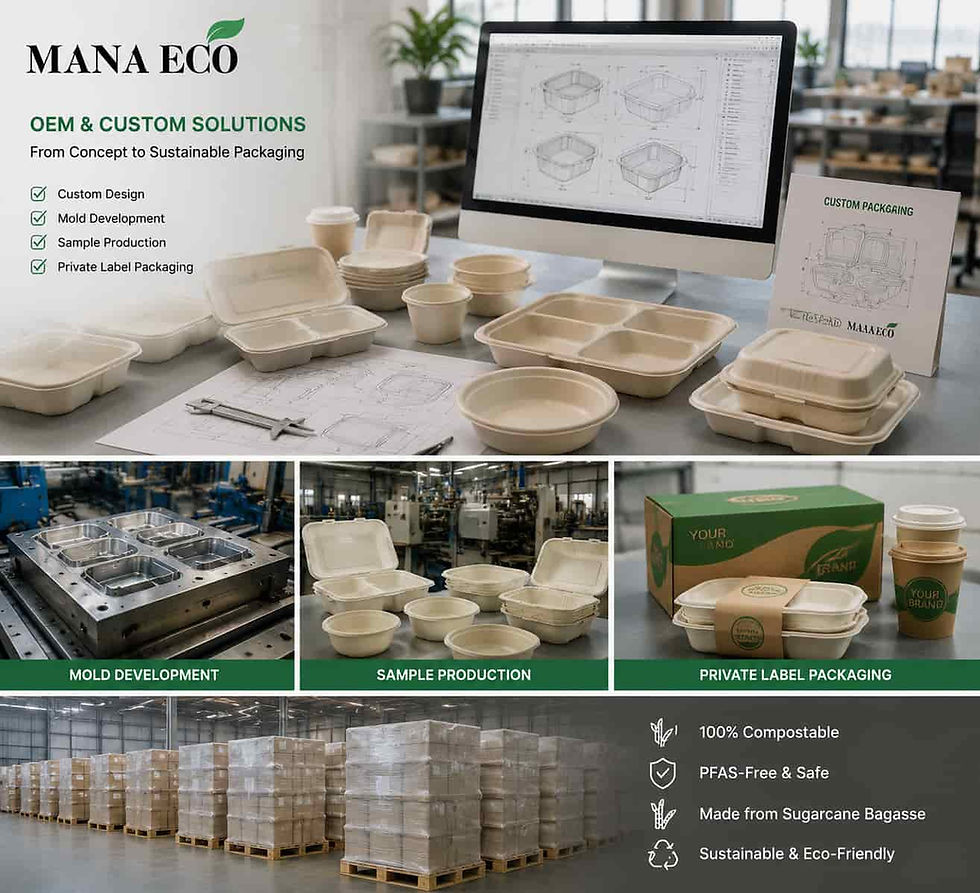
OEM manufacturing has become an important requirement for many sustainable packaging companies.
Instead of selling standard products, businesses increasingly want:
Unique designs
Their own branding
Customized packaging
Market differentiation
A professional OEM compostable tableware manufacturer should provide complete development support.
Custom Mold Development
Custom molds allow customers to create products based on their own requirements.
Customization includes:
Product size
Shape design
Capacity
Compartments
Special structures
The OEM process usually includes:
Step 1: Product Concept
Customers provide:
Product ideas
Reference samples
Technical requirements
Step 2: Design Evaluation
The manufacturer evaluates:
Production feasibility
Mold structure
Manufacturing requirements
Step 3: Prototype Development
Before mass production, samples are developed for approval.
Step 4: Production Mold Manufacturing
After approval, production molds are created for commercial manufacturing.
Sample Mold and Prototype Service
Before investing in full production molds, customers can test product concepts.
MANA ECO provides:
Sample mold + prototype sample service
Cost:
USD 1,000 per set
This service helps customers confirm:
Product appearance
Product function
Market suitability
before entering mass production.
Production Mold Cost
The actual production mold cost depends on:
Product design
Mold complexity
Product size
Technical requirements
For reference:
A customized bagasse tableware production mold is approximately:
USD 15,000–20,000 per set
The final quotation depends on the specific product design.
Private Label Bagasse Tableware
Private label manufacturing allows companies to sell sustainable tableware under their own brands.
A professional OEM compostable tableware manufacturer should provide complete development support, including mold development, product customization, and custom compostable packaging solutions.
Private label solutions are suitable for:
Packaging distributors
Restaurant supply brands
Supermarket suppliers
Sustainable product companies
Custom Logo Printing
For customers requiring branded products, logo customization is available.
Example:
Small-area printing:
USD 0.018 per piece
Suitable for:
Brand logos
Simple graphics
Product identification
For carton packaging:
Customized carton logo printing:
Free of charge
This provides a cost-effective branding solution for bulk buyers.
Factory Production Capability and Manufacturing Process
For international buyers, understanding the manufacturing process is essential when selecting a compostable bagasse tableware manufacturer.
A reliable factory should not only provide products but also have a complete manufacturing system to ensure:
Stable quality
Consistent production
Reliable delivery
Long-term supply capability
MANA ECO focuses on sugarcane bagasse tableware manufacturing and provides professional production solutions for global customers.
Sugarcane Bagasse Raw Material Preparation
The production process begins with sugarcane bagasse.
After sugarcane juice extraction, the remaining fiber material is collected and processed into suitable raw material for molded fiber production.
The preparation process includes:
Raw material cleaning
Fiber processing
Material adjustment
Pulp preparation
The quality of bagasse fiber directly affects:
Product strength
Surface appearance
Production stability
Pulp Manufacturing Process
After preparation, sugarcane fiber is processed into pulp.
During this stage, manufacturers control:
Fiber consistency
Moisture content
Material performance
High-quality pulp helps produce tableware with:
Better structure
Stable shape
Improved durability
Mold Forming Process
The pulp material is transferred into customized molds.
Through advanced molding technology, the fiber pulp is shaped into different products, including:
Plates
Bowls
Containers
Trays
Cups
The mold design determines:
Product dimensions
Capacity
Shape
Structural performance
For OEM projects, customized molds allow customers to create products specifically designed for their markets.
Hot Pressing and Product Finishing
After molding, products go through hot pressing.
This process improves:
Surface smoothness
Product strength
Shape stability
The finishing stage ensures products meet commercial packaging requirements.
Quality Inspection and Packaging
Before shipment, finished products undergo quality inspection.
Quality checks include:
Appearance Inspection
Checking:
Surface condition
Product shape
Visible defects
Dimension Inspection
Checking:
Product size
Weight
Structure consistency
Packaging Inspection
Checking:
Carton condition
Product quantity
Export packaging requirements
A professional quality control process helps ensure customers receive consistent products.
Quality Control and Certifications
For food contact packaging, quality and compliance are critical factors for international buyers.
A professional bagasse tableware supplier should understand different market requirements and provide supporting documentation.
Food Contact Safety
Bagasse tableware is designed for food-related applications.
Depending on the target market, buyers may require:
Food contact testing
Safety documentation
Compliance reports
These requirements help ensure products are suitable for:
Restaurants
Catering businesses
Retail food companies
Compostability Standards
Sustainable packaging buyers often evaluate environmental certifications.
Common compostability standards include EN13432 and ASTM D6400, which are widely referenced for compostable product requirements.
These certifications support customers entering markets with higher sustainability requirements.
Why Certification Capability Matters
For importers and distributors, certification support provides:
Easier market access
Better customer confidence
Stronger product positioning
A professional manufacturer should understand not only production but also the compliance requirements of different markets.
MOQ, Lead Time and Bulk Ordering Process
Before cooperation, buyers should clearly understand production requirements.
This helps avoid misunderstandings and improves purchasing efficiency.
Standard Product MOQ
For standard sugarcane bagasse tableware products:
MANA ECO MOQ:
100,000 pieces per SKU
This quantity allows manufacturers to maintain:
Production efficiency
Stable quality
Competitive pricing
Suitable buyers include:
Importers
Distributors
Restaurant supply companies
Packaging wholesalers
Customized Product MOQ
For OEM customized projects:
Minimum order requirement:
One 20-foot container
Customized products require additional preparation, including:
Mold development
Production setup
Packaging arrangement
Quality approval
Therefore, container-level orders are recommended for custom projects.
Production Lead Time
After:
Deposit payment received
Product specifications confirmed
Standard production time:
Approximately 30 days
The production schedule includes:
Production planning
Manufacturing
Quality inspection
Export packaging preparation
For customized projects, additional time may be required depending on:
Mold development
Sample approval
Product complexity
Bulk Ordering Process
A typical OEM purchasing process includes:
Step 1: Product Requirement Discussion
Confirm:
Product type
Size
Quantity
Application
Step 2: Quotation and Technical Evaluation
Manufacturer provides:
Product quotation
Production feasibility analysis
Customization options
Step 3: Sample Confirmation
Customer checks:
Product quality
Design
Performance
Step 4: Mass Production
After order confirmation:
Production begins according to agreed specifications.
Industries Using Compostable Bagasse Tableware
Compostable bagasse tableware is widely used across multiple industries.
Restaurants and Foodservice Businesses
Restaurants use bagasse products for:
Takeaway meals
Delivery packaging
Daily food service
Benefits:
Sustainable packaging image
Convenient usage
Reliable performance
Catering Companies and Events
Large-scale catering requires:
High-volume supply
Reliable quality
Easy transportation
Bagasse tableware is suitable for:
Conferences
Outdoor events
Corporate catering
Hospitality services
Food Packaging Distributors
Distributors often search for manufacturers that can provide:
Multiple product categories
Bulk supply
OEM support
Working with a complete manufacturer allows distributors to expand their sustainable packaging product portfolio.
Supermarkets and Private Brands
Retail companies increasingly develop sustainable packaging strategies.
Private label bagasse tableware allows brands to create:
Unique product lines
Eco-friendly packaging solutions
Market differentiation
Why Choose MANA ECO as Your Bagasse Tableware Manufacturer?
Selecting a reliable manufacturing partner is critical for building a stable supply chain.
MANA ECO provides global customers with professional sugarcane bagasse tableware manufacturing solutions.Learn more about our manufacturing capabilities, production facilities, and quality management system.
Professional Factory Capability
MANA ECO factory production capability includes:
Production Lines
10 production lines
Machine Configuration
Each production line:
10 machines
Total:
100 production machines
Production example:
For disposable plates:
Each machine produces approximately:
800 kg per day
This production capability supports:
Bulk wholesale orders
Distributor supply programs
OEM manufacturing projects
Long-term cooperation
Complete OEM Manufacturing Support
MANA ECO supports customers with:
Product development
Custom mold manufacturing
Prototype samples
Private label solutions
Logo customization
Bulk production
From initial concept to final shipment, customers can receive complete manufacturing support.
Reliable Partner for Global Buyers
For international buyers, a good supplier should provide more than competitive pricing.
The right manufacturing partner should offer:
Stable production
Consistent quality
Professional communication
Customization capability
Reliable delivery
MANA ECO focuses on helping global businesses build sustainable packaging supply chains through professional sugarcane bagasse tableware manufacturing.
Frequently Asked Questions About Bagasse Tableware Manufacturers
1. What is a bagasse tableware manufacturer?
A bagasse tableware manufacturer produces disposable food packaging products using sugarcane fiber materials.
Products include:
Plates
Bowls
Containers
Trays
Cups
2. Why should buyers work directly with a manufacturer?
Working directly with a manufacturer provides:
Better production control
OEM support
More stable supply
Faster communication
3. What is the MOQ for bagasse tableware?
For standard products:
100,000 pieces per SKU.
For customized products:
Minimum one 20-foot container.
4. Can bagasse tableware be customized?
Yes.
OEM customization includes:
Custom molds
Product designs
Private labels
Logo printing
5. How much does a custom bagasse mold cost?
The cost depends on product design.
Reference:
Production mold:
USD 15,000–20,000 per set.
6. How long is production lead time?
Standard production time:
Around 30 days after deposit payment and order confirmation.
7. Can I request samples before ordering?
Yes.
MANA ECO provides:
Sample mold and prototype sample service:
USD 1,000 per set.
Conclusion: Choosing the Right Compostable Bagasse Tableware Manufacturer
The sustainable packaging industry continues to grow as businesses worldwide search for alternatives to traditional disposable products.
However, choosing the right supplier is the key to successful sourcing.
A professional compostable bagasse tableware manufacturer should provide:
Strong production capability
Stable product quality
OEM customization
Certification support
Reliable delivery
MANA ECO provides sugarcane bagasse tableware manufacturing solutions for importers, distributors, and foodservice businesses worldwide.
With professional production capability and OEM experience, MANA ECO helps customers develop sustainable packaging products for global markets.


Comments