
Bagasse Tableware Manufacturing Process: Wet Press, Dry Press, Materials, Performance and Industry Challenges


Introduction: Understanding the Bagasse Tableware Manufacturing Process

MANA ECO provides sugarcane bagasse tableware solutions for foodservice businesses, distributors, importers and private-label brands looking for sustainable molded fiber packaging. Bagasse tableware has become an increasingly important alternative to conventional plastic foodservice products.
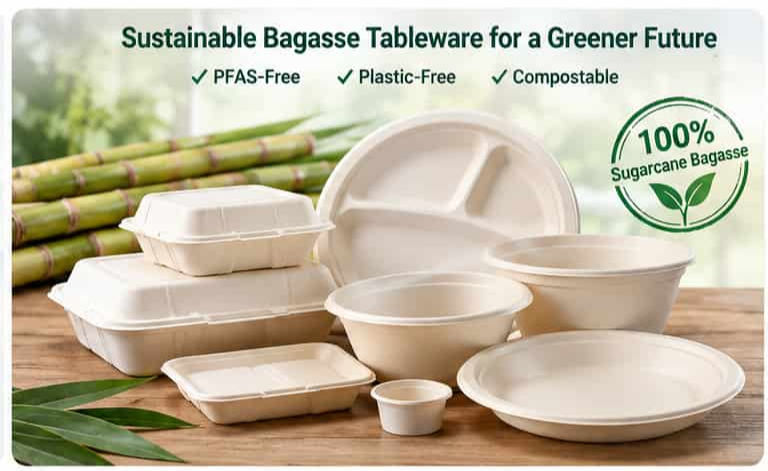
Plates, bowls, trays, clamshell containers and takeaway food boxes can all be manufactured from sugarcane bagasse fiber.
However, simply knowing that a product is "made from bagasse" does not tell buyers very much about its actual performance.
Two bagasse plates may look similar but perform very differently when exposed to hot food, liquids, oil, pressure or extended use.
The difference often comes from the bagasse tableware manufacturing process.
The quality of the final product depends on a combination of factors, including:
Raw fiber quality
Pulp preparation
Fiber refining
Pulp formulation
Molding technology
Hot pressing
Drying
Product geometry
Barrier treatment
Quality control
Application-specific testing
This is why understanding the bagasse tableware manufacturing process is useful for restaurants, distributors, importers, foodservice companies and private-label brands.
The question is not simply:
Is this product made from sugarcane bagasse?
A better question is:
How was the bagasse processed, how was the product formed, and how was its performance verified?
What Is the Bagasse Tableware Manufacturing Process?
The bagasse tableware manufacturing process is the series of material preparation, fiber forming, molding, pressing, drying and finishing steps used to convert sugarcane bagasse into finished foodservice products.
A simplified manufacturing flow looks like this:
Sugarcane Bagasse
↓
Fiber Preparation
↓
Pulping
↓
Refining
↓
Pulp Formulation
↓
Molding / Forming
↓
Dewatering
↓
Hot Pressing or Thermoforming
↓
Drying / Conditioning
↓
Trimming
↓
Quality Inspection
↓
Packaging
The exact sequence depends on the production technology and product design.
For example, a wet-pressed plate and a dry-molded fiber package may use very different forming and drying systems.
Therefore, there is no single universal bagasse tableware manufacturing process.
Instead, manufacturers select and optimize the process according to the required:
Product shape
Strength
Surface quality
Weight
Moisture resistance
Oil resistance
Heat performance
Production volume
Cost target
Step 1: Preparing the Bagasse Fiber
The manufacturing process begins with sugarcane bagasse, the fibrous residue remaining after sugarcane is processed for juice or sugar production.
Bagasse contains cellulose fibers together with hemicellulose, lignin and other components.
Before it can be used for molded tableware, the raw material must be properly prepared.
Typical preparation may include:
Cleaning
Washing
Separation of impurities
Fiber preparation
Pulping
Screening
Refining
The objective is to create a fiber system that can form a stable product with the required mechanical and surface properties.
Fiber characteristics can influence:
Drainage
Fiber bonding
Mold filling
Product density
Surface quality
Drying behavior
Mechanical strength
This means raw material preparation is already an important part of the bagasse tableware manufacturing process.
A manufacturer cannot simply compensate for poor fiber quality at the final molding stage.
Step 2: Pulping and Fiber Refining
After initial preparation, the bagasse fiber is converted into a pulp suitable for forming.
Pulping breaks down the raw material and allows the fibers to be dispersed.
Refining then helps control the characteristics of the fibers and their ability to interact with one another.
The goal is to achieve a balance between:
Fiber bonding
Fiber dispersion
Drainage
Formability
Strength
Surface quality
If the pulp is not properly prepared, manufacturers may experience problems such as:
Uneven product thickness
Weak areas
Poor drainage
Surface defects
Inconsistent weight
Dimensional instability
This is one reason why two factories using the same basic bagasse raw material can produce noticeably different finished products.
The material name alone does not define the product.
The bagasse tableware manufacturing process determines how that material is transformed.
Step 3: Pulp Formulation and Functional Additives
After refining, manufacturers prepare the pulp formulation for the specific product.
Depending on the application, the formulation may be adjusted to improve:
Fiber bonding
Strength
Water resistance
Oil resistance
Forming performance
Surface characteristics
This stage becomes particularly important for foodservice products.
A dry plate used for bread and fruit has very different requirements from a bowl used for hot soup or a takeaway container filled with oily food.
Therefore, the pulp formulation should be considered together with the intended application.
Wet Press in the Bagasse Tableware Manufacturing Process

Wet press molding is one of the most established technologies used for producing molded fiber foodservice products.
A simplified wet-press process is:
Bagasse Pulp
↓
Forming
↓
Dewatering
↓
Wet Molded Fiber
↓
Hot Pressing
↓
Drying / Conditioning
↓
Finished Product
During forming, the fiber is dispersed in water and deposited onto a forming mold.
Water is then removed through drainage and vacuum systems.
The molded fiber is subsequently compressed and heated to consolidate the structure and establish the final shape.
Why Is Wet Press Widely Used in the Bagasse Tableware Manufacturing Process?
Wet press molding provides a useful combination of:
Surface quality
Rigidity
Shape accuracy
Dimensional stability
Stackability
Production maturity
This makes it particularly suitable for many common bagasse tableware products.
Bagasse Plates
Wet pressing can produce plates with:
Good rigidity
Defined edges
Consistent shape
Smooth food-contact surfaces
Bagasse Bowls
It can also be used for:
Soup bowls
Salad bowls
Dessert bowls
Takeaway bowls
Bagasse Clamshell Containers
Clamshells require particularly good dimensional control because the lid and base need to fit together properly.
Bagasse Food Trays
Catering and foodservice trays also benefit from structural rigidity and consistent dimensions.
For these applications, wet press remains an important part of the modern bagasse tableware manufacturing process.
What Are the Advantages of Wet Press Molding?
The main advantage is not simply that wet press can produce a molded product.
Its real advantage is the combination of surface quality, density, structural performance and dimensional control.
During hot pressing, the fiber structure becomes more consolidated.
This can improve:
Surface smoothness
Rigidity
Shape definition
Product consistency
Stacking performance
For premium foodservice applications, these characteristics can be commercially important.
A restaurant or foodservice brand may care about the appearance of the product just as much as its basic functionality.
Dry Press and Dry Molded Fiber Technology
Another important development in the bagasse tableware manufacturing process is dry molded fiber technology.
Unlike traditional wet forming, dry molding attempts to reduce the amount of water used during fiber forming.
The basic concept is:
Prepared Fiber
↓
Fiber Forming
↓
Compression / Molding
↓
Heating / Thermoforming
↓
Finished Fiber Product
Different manufacturers may use different versions of dry forming, dry molding or dry thermoforming.
The technology is attracting attention because it has the potential to reduce some of the water handling and drying requirements associated with conventional wet processes.
What Are the Advantages of Dry Molded Fiber?
One of the biggest potential advantages is reduced water use.
Traditional wet forming requires water to:
Disperse fibers
Transport fibers
Form the fiber web
Be removed during dewatering
The more water involved in the process, the more important water recovery, dewatering and drying become.
Dry molding attempts to reduce this dependency.
Potential advantages include:
Lower water consumption
Reduced dewatering requirements
Potentially lower drying requirements
Faster processing potential
Lightweight product potential
Potentially improved resource efficiency
However, dry molded fiber should not automatically be considered superior to wet pressing.
Its advantages depend heavily on:
Product geometry
Fiber characteristics
Equipment
Production scale
Quality requirements
Manufacturing expertise
Wet Press vs Dry Press: Which Is Better?
This is one of the most important questions when evaluating the bagasse tableware manufacturing process.
The answer is:
Neither technology is universally better.
The better process depends on the product.
Wet Press May Be Better When:
Surface quality is important
Product geometry is relatively complex
Dimensional accuracy is important
High rigidity is required
Premium appearance is required
Large-scale established production is needed
Dry Molded Fiber May Be Attractive When:
Lightweighting is a major priority
Lower water consumption is important
Production efficiency is critical
Product geometry is suitable
The manufacturer has proven dry-forming technology
For this reason, buyers should evaluate the technology based on the application and required performance, rather than choosing a process simply because it sounds newer.
How Does the Manufacturing Process Affect Bagasse Tableware Performance?

A key reason for understanding the bagasse tableware manufacturing process is that manufacturing conditions directly influence the final product.
Important performance characteristics include:
Mechanical Strength
A container needs to maintain its shape under load.
Rigidity
Plates and trays should not flex excessively during handling.
Surface Quality
The food-contact surface should be clean and consistent.
Dimensional Stability
The product should maintain its intended dimensions during production, transportation and use.
Stackability
Disposable tableware is often shipped and stored in large quantities.
Poor dimensional consistency can create unstable stacks.
Water Resistance
Products used with soups, sauces and wet foods need sufficient resistance to liquid penetration.
Oil Resistance
Fried and greasy foods create additional challenges.
Heat Performance
Hot food can affect both the fiber structure and any barrier system used on the product.
The Biggest Challenge: Water Resistance
Cellulose-based fibers are naturally hydrophilic.
In simple terms, they interact readily with water.
This creates a fundamental challenge for molded fiber food packaging.
A dry product can have excellent strength but lose rigidity after prolonged exposure to water.
This matters for:
Soup
Sauces
Wet rice
Salads
Frozen foods
High-moisture meals
The porous structure of molded fiber also creates pathways through which liquid can penetrate.
Therefore, water resistance must be considered during product development rather than treated as an afterthought.
Oil Resistance Is an Even Bigger Challenge
Water and oil behave differently.
Oil and grease can penetrate fiber structures and create problems for products used with:
Fried chicken
French fries
Burgers
Fried rice
Curry
Oily sauces
This is why a product that performs well with water does not necessarily perform well with grease.
For foodservice packaging, the real challenge is often:
PFAS-free + oil resistance + heat resistance
Why PFAS-Free Technology Matters
Historically, fluorinated substances known as PFAS were widely used in grease-resistant food packaging.
The U.S. FDA has also addressed PFAS-containing grease-proofing substances used for paper and paperboard food packaging, including the phase-out of relevant grease-proofing uses in the U.S. market.
They were effective at reducing surface energy and improving oil and grease resistance.
However, regulatory pressure and environmental concerns have made PFAS-free packaging increasingly important.
This has created a major technical challenge for the industry:
How can molded fiber provide effective oil resistance without intentionally added PFAS?
Potential approaches include:
Water-based barrier coatings
Non-fluorinated surface treatments
Internal sizing
Fiber modification
Cellulose-based barriers
Bio-based coatings
The challenge is that a barrier system must do more than simply prevent oil penetration.
It may also need to satisfy:
Food-contact requirements
PFAS-free requirements
Compostability requirements
Cost requirements
Production-speed requirements
Storage requirements
Odor requirements
This makes barrier technology one of the most important areas of innovation in the modern bagasse tableware manufacturing process.
Can Natural Coatings Solve the Problem?
Researchers and manufacturers are investigating a range of bio-based and natural materials, including:
Starch
Chitosan
Alginate
Cellulose derivatives
Shellac
Other bio-based polymers
These technologies are interesting because they may provide useful barrier properties while maintaining a more favorable sustainability profile.
However, there is an important difference between:
Laboratory performance
and
Industrial production performance.
A coating may work well in a controlled laboratory experiment but still face challenges when used on millions of products.
Commercial production also requires:
Stable coating viscosity
Consistent application
Fast drying
Strong adhesion
Low cost
Food-contact compliance
Long-term storage stability
Consistent performance between batches
Therefore, the future of barrier technology will depend not only on scientific performance but also on industrial scalability.
Heat Resistance: Why One Temperature Number Is Not Enough
A common question from buyers is:
"How hot can bagasse tableware withstand?"
But temperature alone does not define performance.
The actual application may involve:
Temperature
Contact time
Moisture
Oil
Mechanical pressure
Microwave heating
Freezing
Transportation
For example, holding hot dry food for several minutes is very different from holding hot soup for an extended period.
Similarly, microwave exposure creates different conditions from simply serving hot food.
Therefore, a professional bagasse tableware manufacturing process should consider application-specific performance rather than relying on a single maximum-temperature claim.
Lightweighting: Using Less Fiber Without Losing Strength
Another major challenge facing the industry is lightweighting.
Using less raw material can potentially reduce:
Product cost
Shipping weight
Material consumption
Carbon footprint
However:
Less material usually means less structural strength.
This creates a difficult engineering objective:
How can manufacturers reduce product weight while maintaining or improving performance?
Possible solutions include optimizing:
Fiber characteristics
Fiber refining
Fiber distribution
Product geometry
Wall thickness
Density
Hot pressing
Mold design
This may become one of the most important areas of competition among molded fiber manufacturers.
The future may not simply be about producing more bagasse tableware.
It may be about producing better-performing products with less fiber.
Dimensional Stability: An Important B2B Requirement
Dimensional stability is sometimes overlooked in discussions about sustainable packaging.
For B2B buyers, however, it can be extremely important.
Consider a clamshell container.
The lid must:
Match the base
Close correctly
Remain stable during transport
Stack properly
Poor process control can lead to:
Warping
Curling
Shrinkage
Uneven edges
Poor lid fit
Unstable stacking
For this reason, dimensional control is a key part of a reliable bagasse tableware manufacturing process.
Fiber Quality Can Affect Production Efficiency
Another important issue occurs before molding.
The fiber itself can influence production efficiency.
If the pulp contains excessive fine particles, for example, it can affect:
Water retention
Drainage
Drying
Equipment cleanliness
Surface quality
This demonstrates why a manufacturer's technical capability should not be judged solely by the molding machine.
The entire production chain matters:
Raw Material
→
Pulp Preparation
→
Fiber Refining
→
Formulation
→
Forming
→
Hot Pressing
→
Barrier Treatment
→
Quality Control
What Are the Biggest Unsolved Problems in Bagasse Tableware?
The modern bagasse tableware manufacturing process has become highly developed, but several technical challenges remain.
1. PFAS-Free Oil Resistance
The industry needs cost-effective solutions that provide strong grease resistance without intentionally added PFAS.
2. Water + Oil + Heat Resistance
Achieving all three properties simultaneously remains challenging.
3. Lightweighting
Manufacturers need to reduce fiber usage without sacrificing strength.
4. Water and Energy Consumption
Traditional wet processes require significant water handling and thermal energy.
5. Dry Molding Scale-Up
Dry molded fiber has significant potential, but consistent high-volume production across different product geometries remains an important development area.
6. Performance Testing
More standardized and application-specific testing is needed for:
Water resistance
Oil resistance
Heat resistance
Mechanical strength
Compostability
7. End-of-Life Infrastructure
A product being technically compostable does not necessarily mean it will actually be composted.
The real environmental outcome also depends on:
Collection
Sorting
Composting infrastructure
Local waste systems
Consumer behavior
Choosing the Right Bagasse Tableware Manufacturing Process for Different Products
Different manufacturing technologies can be used for plates, bowls, clamshell containers, trays and other molded fiber products. You can explore MANA ECO's full range of sugarcane bagasse tableware products to see the available product formats and applications.
There is no single process that is ideal for every application.
Product / Application | Potentially Suitable Technology | Main Considerations |
Bagasse plates | Wet press | Surface, rigidity, dimensional control |
Bagasse bowls | Wet press | Shape, strength, moisture exposure |
Clamshell containers | Wet press / advanced molding | Lid fit, rigidity, stacking |
Food trays | Wet press | Structural performance |
Premium private-label products | Wet press often suitable | Appearance and consistency |
Lightweight fiber packaging | Dry molding potential | Weight and material efficiency |
Oily-food packaging | Molding + barrier system | Grease resistance |
Soup containers | Molding + water barrier | Liquid resistance |
Future high-efficiency applications | Dry molding worth monitoring | Water and energy reduction |
The important point is that the molding technology and barrier system should be evaluated together.
A technically advanced molding process cannot compensate for a poor barrier system when the product is used with oily food.
Likewise, a strong barrier cannot fix a container with poor dimensional stability.
How Should B2B Buyers Evaluate a Bagasse Tableware Manufacturer?
Buyers should look beyond the product catalog.
A professional supplier should be able to discuss the major elements of the bagasse tableware manufacturing process.
Raw Material
Ask:
What type of bagasse fiber is used?
How is raw material quality controlled?
How is pulp consistency controlled?
Manufacturing
Ask:
Which molding technology is used?
How is product weight controlled?
How is pressing temperature controlled?
How is dimensional consistency maintained?
Performance
Ask:
How is water resistance tested?
How is oil resistance tested?
How are hot-food applications evaluated?
How is stacking strength evaluated?
Compliance
Ask:
Is the product PFAS-free?
What testing supports the claim?
What food-contact documentation is available?
Which certifications apply to the actual product?
Production
Ask:
What is the production capacity?
What is the MOQ?
What is the standard lead time?
Can multiple SKUs be produced for one project?
These questions can provide much more useful information than simply asking:
"Are you a bagasse manufacturer?"
To learn more about MANA ECO's background, manufacturing capabilities and approach to sustainable bagasse tableware, visit our About Us page.
The Future of the Bagasse Tableware Manufacturing Process
The future of the bagasse tableware manufacturing process is unlikely to depend on a single revolutionary technology.
Regulatory requirements are also becoming an important part of packaging design and manufacturing decisions. In the EU, the Packaging and Packaging Waste Regulation (PPWR) covers packaging placed on the EU market and includes requirements related to packaging manufacturing, composition and waste management.
Instead, progress will probably come from several areas developing simultaneously.
Better Fiber Engineering
Improved control of:
Fiber length
Fines
Refining
Fiber blends
Better Molding Technology
More precise control of:
Temperature
Pressure
Moisture
Mold geometry
Cycle time
Better Barrier Technology
Especially:
PFAS-free + oil-resistant + water-resistant
Better Lightweighting
Using less material while maintaining structural performance.
Better Dry Processing
Reducing water and energy requirements where the application allows.
Better Testing
Evaluating products under realistic foodservice conditions rather than relying only on simplified laboratory tests.
Bagasse Tableware Manufacturing Process: What Really Determines Product Quality?
When buyers compare two bagasse tableware suppliers, the raw material name is only the starting point.
The final product is influenced by the complete bagasse tableware manufacturing process:
Fiber Quality
Pulp Preparation
Fiber Refining
Formulation
Molding Technology
Hot Pressing
Barrier System
Quality Control
Application Testing
This explains why two products that look similar can perform very differently.
A reliable bagasse tableware product should therefore be evaluated based on its intended application rather than simply its material description.
Conclusion: The Future Is About Performance, Not Just Material
The development of bagasse tableware has moved beyond the simple goal of replacing plastic with agricultural fiber.
The next stage is about improving the entire production system.
Manufacturers need to develop products that combine:
Strength
Lightweight construction
Heat performance
Water resistance
Oil resistance
PFAS-free formulations
Consistent dimensions
Competitive cost
Appropriate end-of-life options
At the same time, the industry needs to reduce water consumption, energy use and material consumption.
Wet pressing remains an important and highly established technology for many plates, bowls, trays and food containers because of its combination of surface quality, rigidity and dimensional control.
Dry molded fiber represents an important direction for applications where lower water consumption, efficiency and lightweighting are particularly valuable.
Ultimately, the most important question is not:
Which bagasse tableware manufacturing process is the most advanced?
It is:
Which manufacturing process can deliver the required foodservice performance with the right balance of quality, cost, resource efficiency and environmental impact?
That is likely to be the key question shaping the next generation of sustainable molded fiber tableware.
Looking for a Reliable Bagasse Tableware Supplier?
If you are sourcing sugarcane bagasse plates, bowls, clamshell containers, trays or other molded fiber food packaging, MANA ECO can help you evaluate suitable product options based on your application, target quantity and market requirements.
FAQ
What is the bagasse tableware manufacturing process?
The bagasse tableware manufacturing process is the series of steps used to convert sugarcane bagasse fiber into finished foodservice products. It can include fiber preparation, pulping, refining, formulation, forming, dewatering, hot pressing or thermoforming, drying, trimming and quality inspection.
Is wet press better than dry press for bagasse tableware?
Not necessarily. Wet press is well established for plates, bowls, trays and containers requiring good surface quality and dimensional stability. Dry molded fiber may provide advantages for suitable lightweight applications and reduced water use.
Why do different bagasse products have different performance?
Because performance depends on more than the raw material. Fiber quality, pulp preparation, refining, molding technology, product geometry, pressing conditions and barrier systems can all influence the final product.
Are PFAS-free bagasse products oil resistant?
They can be, but PFAS-free does not automatically mean oil resistant. Oil resistance depends on the fiber structure, formulation and barrier technology used.
What is the biggest challenge in bagasse tableware manufacturing?
Some of the most important challenges include achieving strong PFAS-free oil resistance, improving water resistance, reducing product weight, lowering water and energy consumption, improving dry-molding scalability and developing practical end-of-life systems.
Why is lightweighting important for bagasse tableware?
Reducing product weight can decrease raw material consumption and shipping weight. However, the challenge is maintaining sufficient strength and rigidity while using less fiber.
How should buyers evaluate a bagasse tableware supplier?
Buyers should evaluate raw material control, molding technology, product consistency, water and oil resistance, food-contact compliance, PFAS testing, production capacity, MOQ, lead time and application-specific quality testing.


Comments